Papakura Military Camp is the New Zealand Army base that most people in Auckland drive past without knowing what sits behind the fence. It is the home of the 1st New Zealand Special Air Service (SAS) Regiment and its support services, and it has been an Army site since 1939. If you are posted there, supporting someone who is, or simply researching what an Auckland Army posting looks like, this guide sets out what the camp does, what has changed on site recently, and how to reach it.
The focus here is the camp itself: its operational role, its training infrastructure, its accommodation, and the practical details you need at the gate.
 NZDF Recruitment · Aptitude & Selection 2026First the test, then the camp.
Clear the NZDF aptitude assessment with proper timed practice before you worry about kit lists.
Papakura Military Camp at a glance
Papakura Military Camp sits in Papakura North, near Auckland on New Zealand’s North Island. It is a military facility operated by the New Zealand Army and forming part of the New Zealand Defence Force. The camp is set in a semi-rural area close to Papakura town centre, which gives it space for training while keeping it inside the wider Auckland urban footprint.
| Type | Owner | Controlled by | Location | Coordinates |
|---|---|---|---|---|
| Army Camp | New Zealand Defence Force | New Zealand Army | Papakura North, Auckland, New Zealand | 37.0497°S 174.9441°E |
The current occupant is the 1st New Zealand Special Air Service Regiment, together with associated support services. That single fact shapes almost everything else about the camp: the facilities, the tempo, and the reason so many personnel live on site rather than commuting in.
As an Auckland-area posting, Papakura is unusual within the New Zealand Army. It is a land-forces base and a key training hub, but its role is tied to Special Operations rather than to general recruit training.
What Papakura is used for today
The New Zealand Defence Force describes Papakura as providing world-class facilities for Special Operations personnel to train to protect New Zealand and its interests. The camp is an operational base first, and a training site in service of that operational role.
The intensity of the training and the calibre of New Zealand’s Special Operations Forces produce special operations capabilities that are compatible with global security partners. That compatibility matters when NZSAS elements work alongside allied units, and it sets the standard the camp’s infrastructure has to meet.
Living on camp is directly linked to that readiness. Mark Bolton, Defence Estate and Infrastructure project lead, put it plainly when the new accommodation opened:
“A lot of our soldiers need to deploy at short notice, so living on camp is essential for our operational capability. To be able to make living areas more homely, is a big part of keeping our soldiers healthy and supporting their overall wellbeing.”
That is the practical logic behind on-camp housing at Papakura. Personnel on high readiness alert need to be close to their equipment and their unit, not stuck in Auckland traffic.
The Battle Training Facility
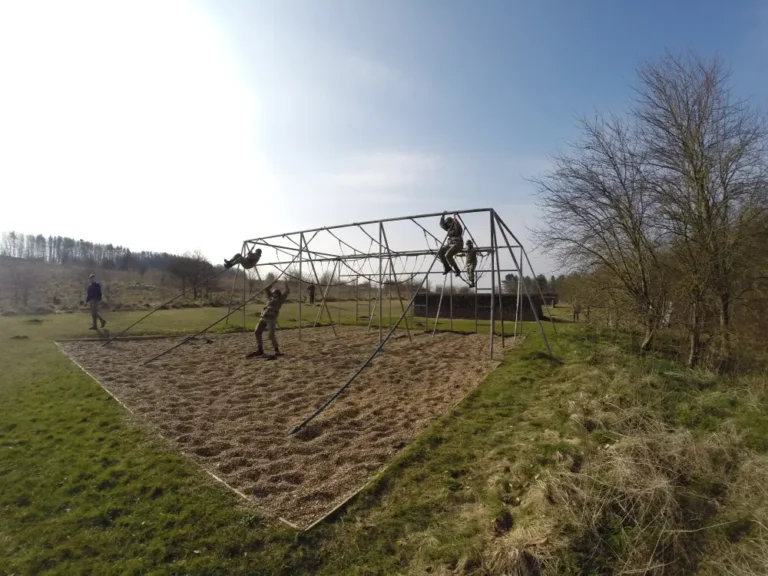
The Battle Training Facility is the centrepiece of training infrastructure at Papakura. The New Zealand Defence Force says the facility reflects the need to train soldiers to operate in complex and high-risk situations. It is one of a series of buildings on camp, and it houses a number of training areas that cover a broad range of scenarios.
Its main gallery and range is used to engage moving and stationary targets. The same space is adaptable: the interior can be reconfigured to mirror the type of building soldiers need to train in at any given time. That flexibility is what separates it from a fixed, single-purpose range.
Beyond the gallery, the Battle Training Facility includes multiple aircraft mockups, vehicle mockups, and a swimming pool for amphibious settings. Together these allow a unit to rehearse an assault on an aircraft, a vehicle interdiction and a water-based approach without leaving the camp.
The facility is not used by the NZSAS alone. Other government agencies with security roles train there too, including the New Zealand Police Special Tactics Group. Sharing the site keeps national response capability aligned across agencies.
Papakura’s wider recorded facilities include administrative buildings, barracks, training areas, vehicle facilities and weapons ranges, alongside the command and control facilities and logistics support facilities that any operational base requires.
From mobilisation centre to permanent Army camp
Work began on 16 August 1939 on a large military training mobilisation centre on the outskirts of Papakura, with training facilities planned for 6,000 men. It was the last of three planned mobilisation camps, built after Burnham and Trentham. The site was compulsorily purchased from the McLennan family under the Public Works Act for defence purposes.
Originally known as the Papakura mobilisation camp, it was the first New Zealand Army camp built with a water-borne sewage system and refrigerated cookhouses. Those two features sound mundane today, but in 1939 they marked a real step up in how the Army housed and fed large numbers of soldiers.
In November 1939, 700 soldiers from the 18th Battalion became the first to occupy the camp.
| Site history | Built | Built by | In use | Garrison information | Occupants |
|---|---|---|---|---|---|
| 1939 | Sir William Stevenson | 1939–present | New Zealand Special Air Service |
How the camp layout developed
Six months after establishment, the camp buildings included a hospital and three battalion areas. Each battalion area contained barracks, a parade ground and administrative offices. That was the working shape of the site through its mobilisation years.
By 1962, Papakura had become home to a number of Regular Force units, including the NZSAS and 161 Battery. The transition from a wartime mobilisation centre to a permanent base for Regular Force units was, by then, complete in practice.
By the end of the 1960s a major works programme had renovated or replaced most of the camp’s World War II infrastructure. That programme reset the camp’s building stock, and much of what followed has been layered on top of it.
NZDF Recruitment · Aptitude & Selection 2026First the test, then the camp.Clear the NZDF aptitude assessment with proper timed practice before you worry about kit lists.
The new living concept for soldiers
Barrack accommodation has been the norm across New Zealand camps and bases since the post-Second World War period. Papakura has broken with that pattern. Frontline soldiers of Ngāti Tūmatauenga, the New Zealand Army, received a significant upgrade with the opening of the first of the camp’s living concept soldiers flats.
The new accommodation consists of five four-bedroom, fully furnished flats. Each flat has a kitchen, a lounge, an apartment-style laundry and dishwashers, with an en-suite bathroom and a private balcony for every room. A separate utility building provides larger commercial washing machines, drying rooms and storage.
Papakura’s Camp Commander framed the change as more than a comfort upgrade:
“These flats not only provide a solution for what has been a challenging period for our soldiers with regards to accommodation, but they also represent a significant generational change in how we house our people. We’re really keen to see how they go so that we may be able to provide more of them in a timely and cost-effective manner.”
The flats were opened by Associate Minister of Defence Chris Penk and blessed at the opening ceremony. Personnel at the camp have welcomed them.
Why the accommodation was needed, and how it was built
Ageing barrack infrastructure on camp had been in use for more than 40 years. The maintenance and upgrade work required prompted the closure of five barracks in 2024, which left a real shortfall in on-camp beds.
The build approach was deliberately unconventional. Mark Bolton, Defence Estate and Infrastructure project lead, explained the off-site construction method:
“We came up with this concept and the flats were built off-site in a factory and transported to camp on the back of a truck. The manufacturer was already building a similar smaller model for farm workers, so this approach ended up costing considerably less than what a traditional building would cost, with added liveability for our people.”
The project took seven months to complete. More accommodation on camp is still needed, but the flats are treated as a step in the right direction for the camp’s infrastructure needs, and they are particularly useful for Papakura soldiers on high readiness alert.
The link back to soldier well-being is explicit in how the NZDF describes the project: better living areas support healthy soldiers, and healthy soldiers sustain operational capability.
Practical access and wellbeing contacts
The Papakura Military Camp gate is accessible 24 hours a day, seven days a week. The gate phone number is 09 296 6800, and the gate is located at 100 Grove Road, Papakura.
Wellbeing support is available by calling 0800 693 348 or by texting 8881. That line is worth saving in advance rather than looking up in a difficult moment.
Papakura in the wider NZ Army base network
Papakura’s origins tie it to a specific moment in New Zealand’s defence planning: it was the last of three planned mobilisation camps, following Burnham and Trentham. Its related-camp list also includes Linton and Waiouru.
Its current role differs sharply from that original purpose. Where the camp was built to process and train large numbers of mobilising soldiers, it now functions as the base for the 1st New Zealand SAS Regiment and its support services, with facilities tuned to special forces requirements rather than mass training throughput.
For anyone mapping the New Zealand Army’s footprint, Papakura is the Auckland node: a land-forces base near a major city, with a Special Operations mission at its core. For broader navigation across the network, see the wider NZ Army bases guide at /nz-army-bases/.
Frequently Asked Questions
How long is NZDF basic training?
Official information about Papakura does not state the duration of NZDF basic training. Papakura is described as the NZSAS base and as a site for complex, high-risk Special Operations training, not as a recruit training school.
What is the most elite military unit in New Zealand?
The New Zealand Defence Force does not publish a ranking of its units by elite status. What it does state is that the 1st New Zealand Special Air Service Regiment is based at Papakura, and that Special Operations Forces train there.
Where are the Army bases in New Zealand?
Papakura North near Auckland is a New Zealand Army base. The camp’s related-camp list also names Burnham, Linton, Trentham and Waiouru. For a fuller picture, use the wider NZ Army bases guide at /nz-army-bases/.
Where are the New Zealand Army training camps located?
Papakura near Auckland originally served as a mobilisation training centre, and it was constructed after the Burnham and Trentham mobilisation camps. A complete current directory of training camps is not set out in the official Papakura material.
Where is NZ Army basic training?
Not at Papakura. The camp is the base for the 1st NZSAS Regiment and home to a Battle Training Facility used for complex and high-risk Special Operations training.
Is there an Army base in Auckland?
Yes. Papakura Military Camp is a New Zealand Army base in Papakura North, near Auckland. It is the base for the 1st New Zealand SAS Regiment and its support services.
What is the postcode for Papakura, Auckland?
The camp’s published details give a physical address rather than a postcode. The Papakura Military Camp address is 100 Grove Road, Papakura.
How can I contact Papakura Military Camp?
The camp gate is open 24 hours a day, seven days a week, at 100 Grove Road, Papakura. The gate phone number is 09 296 6800. Wellbeing support is on 0800 693 348, or text 8881.
What accommodation is available at Papakura Military Camp?
Papakura has five fully furnished, four-bedroom living concept flats with kitchens, lounges, apartment-style laundries, dishwashers, en-suite bathrooms and private balconies. A separate utility building provides commercial washing machines, drying rooms and storage.
What is Papakura Military Camp used for?
It is the operational base for the 1st New Zealand SAS Regiment and associated support services. Its facilities support Special Operations training, including scenario, range, aircraft, vehicle and amphibious training.
Sources
NZDF Recruitment · Aptitude & Selection 2026First the test, then the camp.Clear the NZDF aptitude assessment with proper timed practice before you worry about kit lists.
NZ Army Bases: Region-by-Region Guide to NZDF Postings