

If you have applied for a technical trade with the New Zealand Defence Force and your assessment invitation mentions a mechanical test, this page is for you. The assessment in question is usually the SHL Verify Mechanical Comprehension Test, a short, timed, diagram-based paper on basic mechanical principles.
The good news is that the content is narrow and predictable. You are not being asked to do engineering calculations. You are being asked whether you can look at a diagram of gears, levers or a circuit and reason correctly about what happens next, quickly.
 NZDF Recruitment · Aptitude & Selection 2026Turn theory into a score.
Timed practice sets built around the SHL Verify G+ format, with worked solutions on every question.
This guide covers the format, the principles you need to revise, and a set of worked questions with the reasoning spelled out so you can apply the same method under time pressure.
What the SHL Mechanical Aptitude Test Actually Measures

Mechanical reasoning tests are aptitude or psychometric assessments used during recruitment for technical jobs. They measure how well you understand mechanical concepts and apply them to solve problems. The format is consistent: a diagram shows a mechanical arrangement, and you choose what happens next or which outcome is correct.
The principles are school-level physics. You will meet acceleration, gravity, friction, pressure, kinetic and potential energy, work and power, alongside gears, levers, pulleys, springs, hydraulics and simple electrical circuits. An engineering qualification is not required.
What the test rewards is speed of recall. With well under a minute per question, there is no time to derive a rule from first principles. Fluency with the common rules matters as much as understanding them, which is exactly what practice builds.
Note that spatial reasoning is sometimes administered in the same session. It looks similar on screen, but it measures a different ability from mechanical comprehension, so treat it as a separate revision topic.
Which NZDF Technical Trades May Require It

The mechanical assessment is trade-triggered, not universal. The SHL Verify Mechanical Comprehension Test appears as an additional requirement for certain NZDF technical trades across five areas: engineering, mechanical, aviation, maritime and electrical.
That distinction matters. If you are applying for a non-technical role, you will not automatically face this test. If you are applying for a mechanical or technical position and SHL is running the assessment, the odds are high that you will sit it.
Your invitation is the authority on your own process. Trade requirements vary, so confirm which assessments you are booked for rather than assuming the sequence from a general description.
How it sits alongside Verify G+
Treat the mechanical test as a supplementary, trade-specific assessment rather than a replacement for the general Verify G+ battery. The provider describes the Verify Mechanical Comprehension Test as an online, unsupervised test administered at the beginning of the assessment process alongside other Verify tests.
There is also a verification stage to be aware of. In the SHL process described, passing the unsupervised online test leads to an invitation to the assessment centre, where candidates sit a supervised Mechanical Comprehension Test to vouch for the initial score. In practical terms, a score you cannot reproduce under supervision is not much use to you.
Format, Timing, and Question Style
The selected specification for the SHL Verify Mechanical Comprehension Test is 15 multiple-choice questions in 10 minutes. You interpret images depicting simple mechanical concepts such as levers, gears and pulleys, then select the correct answer.
That works out at roughly 40 seconds per question, and a widely cited preparation target is to spend no more than 30 seconds per question. The margin is thin, so a question you cannot crack in half a minute should be left and revisited if time allows.
Free practice simulations usually mirror this structure: an image plus a statement, multiple-choice answers, and navigation buttons that let you move backwards and forwards to skip or review. Keep working until the timer stops, because unanswered questions score nothing.
One caution about practice material. Sample tests use their own question counts and time limits, which differ from the SHL specification above. Use them to drill the principles and the visual format, not as a guide to the official timing. Across the wider market, a typical mechanical reasoning test runs around 20 to 30 questions in 20 to 30 minutes, which is a different shape from the short SHL screener.
Where the SHL test sits among other formats
If you have researched this topic already, you will have seen other named tests. The table below shows how they compare, which is useful context when you download practice sets and find the timings do not match your invitation.
| Test | Key Features | Personal Insights | Duration | Number of Questions |
|---|---|---|---|---|
| SHL Verify Mechanical Comprehension Test | Assesses understanding of basic mechanical principles, multiple-choice, diagrammatic questions | Comprehensive but challenging due to diagrammatic focus, very popular among employers | 10 minutes | 15 questions |
| Bennett Test of Mechanical Comprehension (BMCT) | Measures understanding of physical forces and mechanical elements in practical situations | Practical and relevant, can be challenging for those unfamiliar with machinery, widely used | 25 minutes | 55 questions |
| Wiesen Test of Mechanical Aptitude (WTMA) | Measures ability to learn to use and maintain equipment and machinery | Straightforward but requires familiarity with equipment and machinery | 30 minutes | 60 questions |
| Barron’s Test of Mechanical Aptitude | Measures understanding of basic mechanical principles and problem-solving ability | Rigorous and comprehensive, one of the more challenging tests | 30 minutes | 60 questions |
| Stenquist Test of Mechanical Aptitude | Assesses mechanical understanding and spatial visualization, visual test | Engaging but can be challenging for those who struggle with spatial reasoning | 2×45 minutes | 2×95 questions |
| Ramsay Mechanical Aptitude Test (MAT) | Short, multiple-choice test that measures ability to learn skills required for mechanical occupations | Less daunting due to its brevity, but requires practical skills | 20 minutes | 36 questions |
The BMCT (Bennett Test of Mechanical Comprehension) and the WTMA (Wiesen Test of Mechanical Aptitude) are long-form assessments; the Ramsay MAT is short. For the SHL Verify test itself, use 15 questions in 10 minutes as your working figure.
The Topics You Need to Revise
The syllabus is finite, which is the best news in this whole process. This overview shows what each question type asks of you.
| Question Type | Skills Assessed | Knowledge Required |
|---|---|---|
| Basic Physical Forces | Understanding of fundamental physical principles | Basic physics, application of principles to real-world situations |
| Levers | Understanding of balance and equilibrium | Principles of balance, basic mathematical calculations |
| Pulleys | Understanding of pulley systems | How pulleys work, force direction and multiplication |
| Gears | Understanding of gear systems | Interaction of gears, visualization of interconnected parts |
| Springs | Understanding of spring dynamics | Hooke’s law, force calculation |
| Simple Electrical Circuits | Understanding of basic electrical principles | Electrical circuits, voltage, current, resistance |
| Hydraulics | Understanding of fluid mechanics | Pascal’s law, pressure calculation |
| Tools | Identification and application of common tools | Familiarity with common tools and their uses |
Beyond that list, expect questions that draw on forces and motion generally: how forces combine, balance and cause movement, how gravity and friction act on a load, and how velocity changes through a mechanism. Basic mathematics is needed for the calculation questions. Familiarity with common mechanical tools helps on the identification items, and inclined planes belong to the same family of simple machines as levers and pulleys, all of which trade distance for force.

Levers, Fulcrums, and Moments
A lever balances when the turning effect on each side of the pivot is equal. That turning effect, the moment, is the force multiplied by its distance from the pivot. A small force far from the pivot can therefore balance a large force close to it.
To answer a lever question, multiply the load by its distance from the fulcrum on one side, then find the force or distance that produces the same product on the other. If a 10 kg weight sits two metres from the pivot, the moment is 20, so an effort one metre from the pivot on the other side must supply 20 units of turning effect, meaning 20 kg.
Moving the effort further from the pivot reduces the force needed. That is the same mechanical advantage you use when a longer spanner loosens a stubborn bolt, and it is worth holding in mind because many diagram questions are really asking which arrangement gives the operator more leverage.
Worked example: balancing a lever
A 10 kg mass sits 1 metre from the pivot. What mass 2 metres from the pivot on the other side balances it?
Set the torque on the left equal to the torque on the right, where torque equals force times length and force equals mass times gravity: 10 × 9.8 × 1 = m × 9.8 × 2. The answer is 5 kg.
The same method handles multiple loads. With 20 lbs at 10 units and 30 lbs at 5 units on the left, the left-hand torque is (20 × 9.8 × 10) + (30 × 9.8 × 5). Balancing that with a single mass at 10 units on the right gives 35 lbs. Add up every moment on one side, then solve for the unknown on the other.
A third variant asks for force rather than mass. For a 30-pound box at 12 feet balanced by an effort at 15 feet: (30 × 12) = (x × 15), so x = 24 pounds.
NZDF Recruitment · Aptitude & Selection 2026Turn theory into a score.Timed practice sets built around the SHL Verify G+ format, with worked solutions on every question.
Pulleys and Lifting Force
Pulleys come in two flavours, and one sentence covers most questions. A movable pulley shares the load across the rope sections supporting it, which saves 50% of the force but does not change its direction. A fixed pulley changes the direction of the applied force without saving force.
With two rope sections directly supporting a load, the effort needed is half the load in the idealised examples used in practice material. That is why a worked question showing a 24 lb weight on a movable pulley arrangement gives 12 lbs as the force required.
When you meet a pulley diagram, count the rope sections that actually support the moving load, then divide. Do not count the rope you are pulling on if it only redirects the force.
Belt-driven pulleys follow a different rule. If the belt between two wheels is not crossed, both turn in the same direction. If it is crossed, they turn in opposite directions. So when a question asks which of two wheels turns the same way as the driver, trace the belt and look for the cross.
Gears, Wheels, and Belts
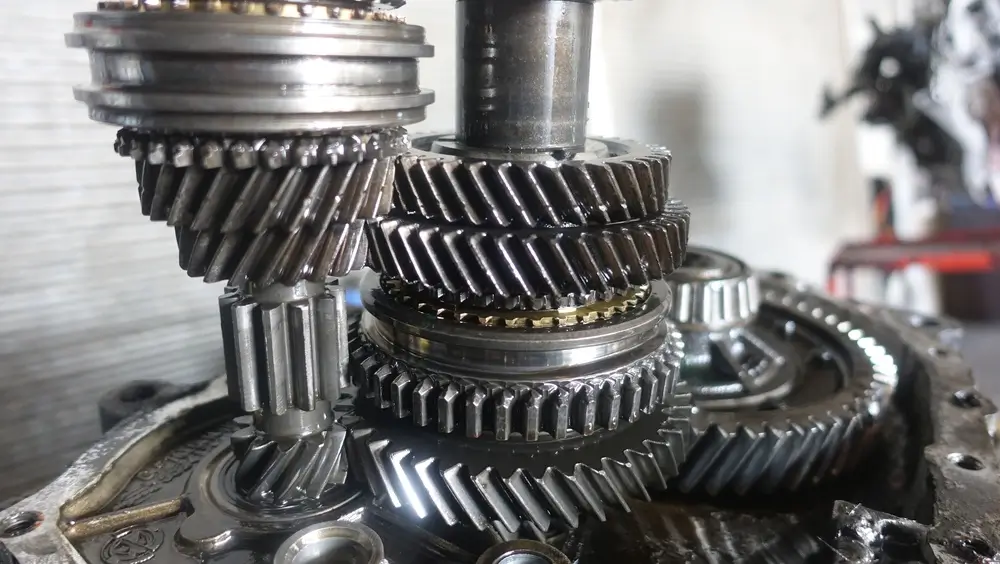
Two meshed gears turn in opposite directions, and the direction alternates along a train of meshed gears. Gears joined on the same axle turn together at the same speed. Work along a gear train one pair at a time and the answer follows.
Speed is governed by teeth. Gear speed is inversely proportional to the number of teeth, so a gear with twice as many teeth turns at half the speed of its neighbour. If a small cog with 5 teeth completes 40 revolutions per second and drives a cog with four times as many teeth, the larger cog completes 10 revolutions per second. You never need to count more than the gear ratio.
Worked example: gear direction and speed
Gear X turns clockwise at a constant speed of 10 rpm and meshes with an identical gear Y. How does Y turn?
Meshed teeth must pass through the same linear velocity, and both gears have the same number of teeth, so Y turns anticlockwise at 10 rpm. The direction reverses; the speed does not.
Now a belt-driven variant. Drive wheel X rotates clockwise at 10 rpm and is connected by an uncrossed belt to a smaller wheel Y. Angular velocity equals linear velocity divided by the wheel’s circumference, so the ratio of angular velocities is the inverse ratio of the radii. Because Y has the smaller radius, Y turns clockwise and faster than X.
That is the key distinction to hold on to: with meshed gears, speed depends on teeth; with belts and unmeshed wheels, velocity depends on the radius. Larger wheels cover more distance per turn, so they rotate more slowly than smaller ones on the same belt.
Pressure, Hydraulics, and Springs
Pressure and hydraulics sit squarely inside the SHL mechanical syllabus for the relevant technical trades, so do not skip them. The underlying rules are Pascal’s law for pressure in a confined fluid, and the fact that pressure in a liquid depends on the depth of the column above the point you are measuring.
Diagram questions here tend to be qualitative. One NZDF-labelled practice sample, for instance, shows a bucket with a leak on its lower side and asks what happens to the pressure at the bottom as water escapes. The sample poses the question without publishing a derivation, so treat it as a prompt to reason from the depth rule rather than as a stated answer.
Springs appear in the same family of questions. Revise how springs behave in series and in parallel, and the basic relationship between force and extension under Hooke’s law. Read the stated conditions in the diagram before you calculate anything, because these questions often hinge on a detail such as which springs share the load.
Simple Electrical Circuits
Electrical circuits are part of the assessment for technical trades, covering circuit symbols, current, voltage and resistance. Two rules answer most items.
A series circuit has one path for current. An open switch or a failed component stops the whole circuit, which is why a question about two switches in series with a bulb requires both switches closed for the bulb to light.
A parallel circuit provides multiple paths and applies the same voltage across its branches. One failed branch does not necessarily stop the others, so a question asking which bulbs stay lit after a switch opens is really asking you to identify which branch you have just broken.
Spend ten minutes relearning the standard symbols for cells, switches, resistors and bulbs. Under time pressure, misreading a symbol costs more than misapplying a rule.
Preparation, Timing, and How Scores Are Read
Start with the rules rather than the questions. Revise forces, levers, pulleys, gears, pressure, hydraulics and circuits until each rule comes back without effort, then move to timed practice. Practising before the assessment is the standard recommendation precisely because it improves both speed and accuracy.
Once the principles are solid, practise against the clock. Work at a pace of no more than 30 seconds per question so that the real time limit does not surprise you, and get comfortable leaving a hard question and returning to it.
After each practice set, review the reasoning behind every answer you got wrong and every one you guessed correctly. Understanding why an answer is right is what transfers to a new diagram; memorising answer patterns does not.
There is no universal pass mark
Do not chase a single percentage. Mechanical reasoning thresholds are set by employers according to the assessment, the role and the comparison group used, so a score that clears the bar for one trade may not for another. Three independent test-prep publishers agree on this point; the 80% figure that circulates online is a simplification.
It helps to understand how your result is reported. The table below sets out the components you may see.
| Component | Description | Example |
|---|---|---|
| Raw Score | Total number of questions answered correctly | If a test-taker answers 26 questions correctly, their raw score is 26 |
| Percentile Ranking | Compares the test-taker’s performance to that of a norm group | A percentile ranking of 70 means the test-taker performed better than 70% of the norm group |
| Sub-scores | Scores for different sections or types of questions | Some tests provide sub-scores to highlight strengths and weaknesses |
| Score Range | Indicates the minimum and maximum possible scores | The test-taker’s score can be compared to these ranges to assess their performance |
| Ramsay MAT score interpretation | Use the employer or test administrator’s official score report and comparison group | Do not apply age-based child norms or generic T-score conversions unless they appear in your official Ramsay report |
Your next step is simple: pick one topic from the syllabus table above, relearn the rule, then work through timed practice questions on that topic until the method is automatic. Gears and levers give the fastest return, because they account for a large share of the diagram questions and both come down to a single ratio.
Frequently Asked Questions
What is the SHL Verify Mechanical Comprehension Test?
It is a timed, diagram-based assessment of basic mechanical principles such as levers, gears, pulleys, pressure, hydraulics and simple circuits. The specification used here is 15 multiple-choice questions in 10 minutes. It applies to selected technical trades rather than to every NZDF applicant.
Which NZDF trades may require the mechanical test?
The relevant areas are engineering, mechanical, aviation, maritime and electrical trades. The requirement is trade-specific, so not every NZDF candidate sits this additional assessment.
When is it added to Verify G+?
It is an additional assessment triggered by your technical trade, not a replacement for Verify G+. The SHL mechanical test is described as being administered alongside other Verify tests at the start of the process, with selected technical trades carrying the extra requirement. Rely on your assessment invitation for the exact sequence.
How many questions are on the SHL mechanical test, and how long is it?
Fifteen questions in 10 minutes. Timings from other mechanical test formats, including free practice simulations, do not apply to the SHL Verify test.
What is on a mechanical aptitude test?
Forces and motion, levers and moments, pulleys, gears and belts, pressure and hydraulics, springs, and simple electrical circuits. Questions are generally diagram-based and ask you to predict movement, compare force or speed, or identify the result of a circuit or hydraulic change.
What questions are on the SHL mechanical comprehension test?
Expect visual questions on levers, pulleys, gears, pressure, hydraulics and circuits. Typical items ask which gear turns clockwise, how much force balances a lever, which pulley arrangement needs less effort, what happens to pressure in a container, or which bulbs light when a switch changes position.
Is the SHL mechanical aptitude test hard?
It can be challenging, because the questions are diagrammatic and the time limit is tight, leaving no room to work a principle out from scratch. An engineering qualification is not required, but you need a confident grasp of school-level mechanical and electrical rules and the ability to apply them fast.
How can I pass a mechanical aptitude test?
Revise the core rules for forces, levers, pulleys, gears, pressure, hydraulics and circuits, then practise timed questions with worked explanations. Build accuracy and recall together, and review the reasoning behind your mistakes instead of memorising answer patterns.
Where can I find free mechanical aptitude tests?
Several test publishers offer free mechanical reasoning samples with diagram-based questions, answer feedback, and timed or untimed modes. Use them to drill the principles and the visual format, but do not assume a sample’s question count or time limit matches the official SHL format.
Can you still get hired if you fail a mechanical aptitude test?
There is no single hiring rule that covers every employer and role. One SHL description says that passing the online test leads to the assessment centre, while other test publishers note that employers set their own thresholds. The outcome depends on the NZDF process and the requirements of your trade, so a failed result cannot be assumed to be recoverable.
Sources
NZDF Recruitment · Aptitude & Selection 2026Turn theory into a score.Timed practice sets built around the SHL Verify G+ format, with worked solutions on every question.

NZDF Pilot: RNZAF Selection, Tests and Training Explained

SHL Aptitude Test: Format, Scoring and Preparation Guide