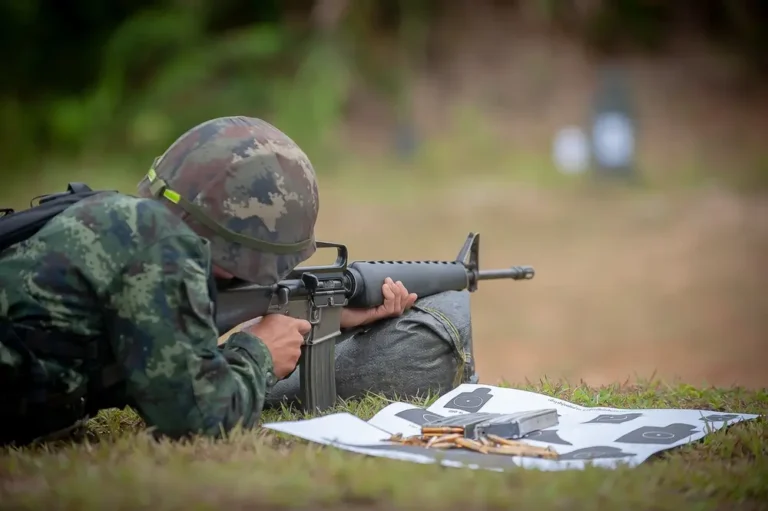
If you are weighing up a New Zealand Army career, the structure chart is more useful than it looks. It tells you which units exist, where they sit, and what kind of work each one generates. Read it properly and you can match a trade to a command, a camp and a posting before you fill in an application.
This guide walks through the NZ Army structure from the top down: the three main commands, the operational brigade, the training organisation, the support and logistics side, and the Army Reserve. Along the way it flags where each part connects to a real career pathway.
 NZDF Recruitment · Aptitude & Selection 2026From curious to candidate.
Selection opens with a timed cognitive assessment. Here is exactly how to prepare for it.
How to Read the New Zealand Army Structure as a Trade Map
The New Zealand Defence Force (NZDF) describes the Army as built around three main commands: Land Component Command, Special Operations Component Command and Army General Staff. A further group of Army personnel sits inside Defence Logistics Command (Land), providing logistics support to the service.
Army General Staff is the Army headquarters. It supports the Chief of Army with raising, training and sustaining the New Zealand Army. Major General Rose King currently holds the role of Chief of Army. If you are looking for the strategic and corporate side of Army work, this is where much of it is planned rather than executed.
Land Component Command owns the operational and training units. It is the part of the structure most soldiers spend their career inside. Special Operations Component Command is separate by design, and it manages New Zealand’s Special Operations Forces.
Regular Force, Reserve Force and civilian staff
Three workforce types run across the whole structure. The Regular Force makes up the majority of Army numbers and serves full time. The Army Reserve supports the Regular Force and contributes to the wider community in times of need. Civilian staff support the Army at all levels, often bringing specialist expertise across a wide range of functions.
That distinction matters when you read a unit list. A battalion name on the NZDF structure page can be a Regular Force unit based at a specific camp, or a Reserve battalion drawing part-time soldiers from a whole region. The trade might look similar; the commitment does not.
Using structure to compare career directions
A practical way to use the structure is to work backwards. Decide whether you want combat, training, support or special operations work, then find the command that generates it. Combat trades sit under 1st (NZ) Brigade. Instructional and course-based roles concentrate in Training and Doctrine Command. Health, military police and logistics roles sit in the Joint Support Group and Defence Logistics Command (Land).
Land Component Command: The Operational and Collective-Training Hub
The purpose of the Land Component is to generate individuals and force elements that are professional, combat-focused and capable of conducting land-based operations in support of New Zealand’s interests. That single sentence explains almost everything about how the command is organised.
Land Component Command comprises four organisations:
- 1st (NZ) Brigade
- Training and Doctrine Command (NZ)
- Joint Support Group
- Regional Support (Army)
Together these command and manage the operational and training units of the New Zealand Army.
One split runs through the whole command and is worth understanding early. Army training is divided between collective training, where teams train together, and individual training, delivered through structured formal courses. The brigade owns most of the collective side. Training and Doctrine Command owns most of the individual side. Your first year in uniform will be dominated by individual courses; your later career leans increasingly on collective exercises with your unit.
1st (NZ) Brigade: The Main Map of Combat Units
The mission of 1st (NZ) Brigade is to provide combat-ready land forces to deliver against contingencies that secure and defend New Zealand’s interests. The brigade and its units manage and undertake the majority of the Army’s collective training, which is why brigade postings feel busier in the field than headquarters or school postings.
The NZDF structure page lists the brigade’s operational units as:
- 1st Battalion, Royal New Zealand Infantry Regiment
- 2nd/1st Battalion, Royal New Zealand Infantry Regiment
- 2/4 Battalion, Royal New Zealand Infantry Regiment
- 3/6 Battalion, Royal New Zealand Infantry Regiment
- 5/7 Battalion, Royal New Zealand Infantry Regiment
- Queen Alexandra’s Mounted Rifles
- 16th Field Regiment
- 2nd Engineer Regiment
- 1st Command Support Regiment
- 2nd Combat Service Support Battalion
- 3rd Combat Service Support Battalion
Read across that list and the capability families become obvious: infantry, mounted or armoured, field artillery, engineering, command support and combat service support. New Zealand military unit directories organise regimental information along similar lines, grouping units into armoured, artillery, cavalry and infantry categories. Those directories are indexes, not a current recruitment structure, so treat the NZDF page as the reference when you are mapping a trade.
Brigade membership is a reasonable proxy for daily life. A posting to an infantry battalion of the Royal New Zealand Infantry Regiment means field time and section-level work. A posting to 1st Command Support Regiment or a combat service support battalion means your trade skill drives the job, with field deployments layered on top.
Choosing Between Combat Trades
The entry pathway into combat roles has been simplified. For future intakes, you join the Army as a Combat Specialist, are introduced to the strategy and skills for combat, then branch into Infantry, Gunner or Armoured soldier towards the end of basic training. Defence Careers lists six roles under the Army’s Combat & Special Operations specialisation.
That structure has a practical benefit. You do not have to lock in a final combat trade before you have handled a weapon, carried a pack or worked in a section. The branching decision comes after you have some evidence about your own strengths.
Infantry work is dismounted and section-based, with proficiency built in navigation, weapon handling, fieldcraft, survival and marksmanship. Gunner work sits with field artillery. Armoured work is built around vehicles, including the NZLAV. Support trades in the brigade suit people who want a technical or logistics skill that also travels on operations.
The Infantry Pathway: From Combat Specialist to Unit Posting
Infantry is described by Defence Careers as a front-line role and the backbone of Army service. It demands sustained physical and mental stamina across a career, not just during selection. Most of the time is spent moving between camp and field environments, developing fieldcraft, weapon training, navigation, communications, marksmanship and physical fitness.
Basic training for Regular Force recruits runs at Waiouru Military Camp. NZDF states that Regular Force Recruit courses are 17 weeks long, covering Army customs and protocol, fitness, drill, field skills, weapon training, first aid, organisation and administration.
Combat Corps Training follows. It prepares infantry soldiers to operate as part of a rifle section and can extend into specialist weapons, advanced fieldcraft, combat casualty first aid, and work alongside armoured vehicles or helicopters.
After job training, infantry soldiers are posted either to 1 RNZIR at Linton Military Camp or to 2/1 RNZIR at Burnham Military Camp. That is the point where the structure stops being an abstract chart and becomes a town, a camp and a company.
Pay is published openly for the role.
| Status | Salary |
|---|---|
| Under training | $69,833 |
| Future potential earnings | $100,996 |
Field training is a constant across the pathway, and units make a point of getting out of camp.
“Having the opportunity to get out the door and train in this part of the country is great for the battalion.” — Lieutenant Tony Calder-Steele
NZDF Recruitment · Aptitude & Selection 2026From curious to candidate.Selection opens with a timed cognitive assessment. Here is exactly how to prepare for it.
Ngāti Tūmatauenga and the Motorised Infantry Change
The infantry side of the structure has just changed. On 5 December 2025, at a parade at Linton Military Camp attended by Chief of Army Major General Rose King, the amalgamation of 1st Battalion, Royal New Zealand Infantry Regiment and Queen Alexandra’s Mounted Rifles was formally marked, standing up a new Motorised Infantry Battalion named Ngāti Tūmatauenga.
The new unit retains the 1 RNZIR designation, and one of its sub-units retains the QAMR name. The detailed company and squadron breakdown of the amalgamated battalion has not been published in the material available, so treat any org chart you find for it with caution until NZDF updates its structure page.
The rationale given was combat readiness.
“The amalgamation of the two units was a deliberate decision made to enhance and better enable the combat readiness of one of our key military outputs – that of a Motorised Infantry Battle Group.” — Major General Rose King, Chief of Army
The distinction between the two terms matters if you are trying to place yourself in the structure. A Motorised Infantry Battalion combines infantry, armoured personnel and support trades in one unit. A Motorised Infantry Battle Group is broader, pulling in artillery, engineering and logistics elements to fight as a combined formation.
Major General King said the concentration of expertise in 1 RNZIR would let the unit deliver more consistent, higher-quality collective training, in a safer manner, better preparing soldiers for challenges in the region.
“What this new unit will show is that our adaptability, and readiness to evolve to the current state of warfare and the future fight, is a fundamental strength.” — Major General Rose King, Chief of Army
For a recruit, the practical read is this: mounted and dismounted skills are being brought closer together in one battalion. Lieutenant Colonel Caleb Berry summarised the intent as training hard, integrating mounted and dismounted expertise, and mastering the fundamentals.
Army Reserve: Regional Units and Part-Time Trade Options
The Army Reserve Force, formerly known as the Territorial Force, is the part-time component. Reserve soldiers and officers supplement the Regular Force on local and international operations, and Reservists come from every background: students, tradespeople, lawyers, recent graduates.
NZDF states that the Army Reserves have three reserve battalions: 2/4 Battalion RNZIR, 3/6 Battalion RNZIR and 5/7 Battalion RNZIR. That gives the Reserve a regional footprint rather than a single-camp one.
2/4 Battalion RNZIR is the only Army Reserve battalion in the South Island. It comprises three rifle companies, A, B and C, and is an amalgamation of two historic formations: the 2nd Canterbury, Nelson, Marlborough, West Coast Battalion Group and the 4th Otago and Southland Battalion Group.
Reserve training and time commitment
Initial Reserve training runs in three stages, totalling approximately 7 weeks. Module 1 is a two day introduction to the New Zealand Army and Reserve Force service, run throughout the calendar year in Auckland, Wellington or Christchurch. Module 2 is a 38 day residential Basic Training course at Waiouru Military Camp. Corps Training, the initial trade-specific stage, is equivalent to 14 days. Module 2 and Corps Training take place in November, December and January.
After that, Reserve soldiers generally train one weekend per month plus the occasional weekday evening, with a minimum expected commitment of 20 days per year. Personnel train annually to maintain the core soldiering tenets of Move, Shoot, Communicate and Medicate.
Reserve soldiers are trained in basic soldier skills including weapon handling, first aid, fieldcraft, navigation, fitness training and teamwork, then develop leadership and planning skills as their part-time career advances. Some Reservists also bring civilian expertise from fields such as medicine, engineering, IT and project management into a military environment, which is a genuine advantage of the part-time pathway.
Training and Doctrine Command: Where Individual Trade Training Fits
Training and Doctrine Command works to the vision of “training tomorrow’s soldiers and commanders, today.” It manages the delivery of the majority of the New Zealand Army’s individual training, which makes it the command every soldier passes through before reaching their unit.
Its organisations are:
- Army Command School
- Mission Command Training Centre
- Land Operations Training Centre
- The Army Depot
- New Zealand Collective Training Centre
- Adaptive Warfighting Centre
- New Zealand Army National Marae, Rongomaraeroa o ngā hau e whā
**The Army Depot is the name to remember on the recruit training side. Course-based roles, instructional postings and doctrine work all sit inside this part of the structure, and it is a common second-career destination for experienced soldiers.
The officer pathway
Officer training runs through the same command. The New Zealand Commissioning Course lasts 38 weeks, and Defence Careers describes the officer training programme as a 12 month course overall, opening with 12 weeks of Initial Induction Training. The education requirement listed for Army Officer entry is an NCEA Level 2 certificate.
One assessment gives a sense of the standard. NZDF reported in May 2025 that Exercise Nemesis is a five day test of officer cadets’ resilience, leadership and decision-making under pressure, during which cadets may get as little as four and a half hours of sleep across the whole exercise.
The standard offer of service for an Army Officer is 15 years, though Defence Careers is explicit that this does not oblige either party to complete that period. Once initial training is complete, service can be ceased with 3 months notice.
Support, Logistics and Enabling Trades
Not every Army trade is combat. The Joint Support Group, one of the four organisations under Land Component Command, holds three units that generate a large share of the Army’s enabling roles.
The Force Health Organisation runs health services supporting daily camp and base operations, including medical and dental services, gymnasiums and rehabilitation. The Deployable Health Organisation provides health support for both training and operations. The Joint Military Police Unit delivers law enforcement, crime prevention, investigation of serious and criminal incidents, and custodial support to the NZDF in New Zealand and overseas.
Logistics sits slightly outside the Land Component. Defence Logistics Command (Land) is organised into the Directorate of Land Engineering, the Logistics Delivery Group, Operations and Systems, and the Business Support Unit. Army personnel posted there keep equipment, supply and engineering support running.
Civilian roles run alongside all of this. NZDF civil staff bring specialist skills in communications and information systems, finance, property management, human resources, legal services, public affairs and strategic management. If you want to work for Defence without enlisting, this is the part of the structure to look at.
Special Operations and the Wider Force
Special Operations Component Command sits alongside Land Component Command and Army General Staff as a distinct major component, and it is responsive to the Commander Joint Forces New Zealand and the Chief of Defence Force. It manages New Zealand’s Special Operations Forces.
Those forces respond to high-priority opportunities or threats that do not require numerical strength, and where the task or environment rules out conventional forces. They are highly capable and enabled by the wider Defence Force, providing military special operations support to domestic, regional and global security situations.
The 1st New Zealand Special Air Service Regiment conducts strategic and tactical intelligence gathering, limited offensive operations, recovery operations and counter-terrorist operations beyond the range or capability of conventional Army units. That last phrase is the operative one: the command exists precisely because some tasks fall outside what brigade units are built for.
Because it is a separate command, entry into this pathway is not a straight continuation of a brigade posting. Plan it as a distinct direction rather than an automatic next step.
Force Size, Readiness and Career Context
NZDF reports Army numbers as at 30 November 2025: 4,358 in the Regular Force, 2,080 in the Reserve Force, for a total of 6,438. Across the whole Defence Force, NZDF reports 15,305 people, comprising 9,165 Regular Force personnel, 3,245 Reserve Force personnel and 2,895 civilians. The Army is the largest single component in both the Regular and Reserve categories.
Headcount alone does not describe capability. Official Army material presents the service as a world-class, combat-ready force that is modern, agile and highly adaptive, with a mission to provide land forces trained, led and equipped to win as part of an Integrated Defence Force. NZDF also states that it leverages modern equipment and technology to improve training, enhance decision making and optimise capabilities.
That framing answers the common question about why the Army is small in absolute terms. It is designed as the land component of an integrated force rather than as a standalone mass army, and the historical record of New Zealand Army reorganisation links structural change to shifting defence needs and financial constraints. No single current official explanation for the size has been published.
Applying: What the Process Looks Like
Once you have picked a direction in the structure, the application mechanics are straightforward but not fast. Defence Careers describes the process in 8 stages, from gathering documents through to joining an intake, and states that full processing takes approximately 3 to 6 months.
A few timing details are worth planning around. The NZDF team may acknowledge a submitted application within ten working days. Copies of the requested documents are required within two weeks of applying, so gather identity and education records before you start.
Fitness is assessed early. The Defence Careers Assessment Day table sets the beep test minimum at 7.10 for male applicants and 5.09 for female applicants. On physical requirements, there is no general maximum height, but applicants over 1.96m may be unsuitable for specific trades.
Frequently Asked Questions
What is the structure of an Army?
There is no single universal answer. For the New Zealand Army, the practical map runs from Army General Staff and the Chief of Army through Land Component Command, Special Operations Component Command, training organisations, operational units and support functions. Land Component Command itself contains 1st (NZ) Brigade, Training and Doctrine Command, Joint Support Group and Regional Support (Army).
What tier is NZ SAS?
NZDF does not assign the NZ SAS a formal numbered tier. It places the 1st New Zealand Special Air Service Regiment within Special Operations Component Command and describes it as handling missions beyond the range or capability of conventional Army units.
Does NZ have a strong Army?
Official NZDF and Defence Careers material describes the New Zealand Army as combat-ready, modern, agile and highly adaptive, with a mission to provide trained, led and equipped land forces as part of an Integrated Defence Force. No independent global strength ranking is published in that material.
What are all the regiments in the Army?
There is no single timeless, exhaustive list. For career mapping, the useful categories are infantry, mounted or cavalry, artillery, engineering and support, with 1 NZSAS located separately under Special Operations Component Command. Directory-style index pages are not a current recruitment structure.
What is the most elite military unit in NZ?
NZDF does not publish a formal ranking of units by elite status. It identifies 1 NZSAS Regiment as part of Special Operations Component Command and describes its specialist missions, including strategic and tactical intelligence gathering, recovery operations and counter-terrorist operations beyond conventional Army capability.
What are the different battalions in the New Zealand Army?
The NZDF structure page lists 1st Battalion, 2nd/1st Battalion, 2/4 Battalion, 3/6 Battalion and 5/7 Battalion of the Royal New Zealand Infantry Regiment among 1st (NZ) Brigade’s operational units. The December 2025 stand-up of Ngāti Tūmatauenga as a Motorised Infantry Battalion retaining the 1 RNZIR designation means you should check the latest official structure before treating any list as current.
What are the different regiments in the New Zealand Army?
For a trade-focused overview, the relevant families are the Royal New Zealand Infantry Regiment, Queen Alexandra’s Mounted Rifles, 16th Field Regiment, 2nd Engineer Regiment, 1st Command Support Regiment and the combat service support battalions. General directories also group New Zealand regimental information into armoured, artillery, cavalry and infantry categories, which is not a complete current order of battle.
How many troops does NZ have?
NZDF reports 15,305 personnel overall: 9,165 in the Regular Force, 3,245 in the Reserve Force and 2,895 civilians. For the Army specifically, NZDF reports 4,358 Regular Force and 2,080 Reserve Force members as at 30 November 2025, a total of 6,438.
Is it difficult to join the TA?
The Army Reserve, formerly the Territorial Force, requires applicants to have completed secondary education, be a New Zealand citizen or permanent resident, be eligible for a security clearance and be medically fit. Initial training runs in three stages totalling approximately seven weeks, followed by an expected commitment of one weekend per month and at least 20 days per year.
Why is the NZ Army so small?
No single current official explanation is published. Historical accounts of New Zealand Army reorganisation link structural change to shifting defence needs and financial constraints, while current NZDF material presents the Army as a combat-ready land component operating within an Integrated Defence Force rather than a standalone mass army.
Next Step
Pick one command and one unit from the structure above, then read the matching role page on the official Defence Careers site. If combat work appeals, look at the Combat Specialist entry and the infantry pathway to Linton or Burnham. If you want to keep a civilian career, start with the Army Reserve battalion covering your region and the three-stage initial training schedule. Then give yourself three to six months for the application to run its course.
Sources
NZDF Recruitment · Aptitude & Selection 2026From curious to candidate.Selection opens with a timed cognitive assessment. Here is exactly how to prepare for it.
NZDF: New Zealand Defence Force Roles, Services and How to Join
NZ Army Uniform: Orders of Dress, NZMTP Combat Kit Guide