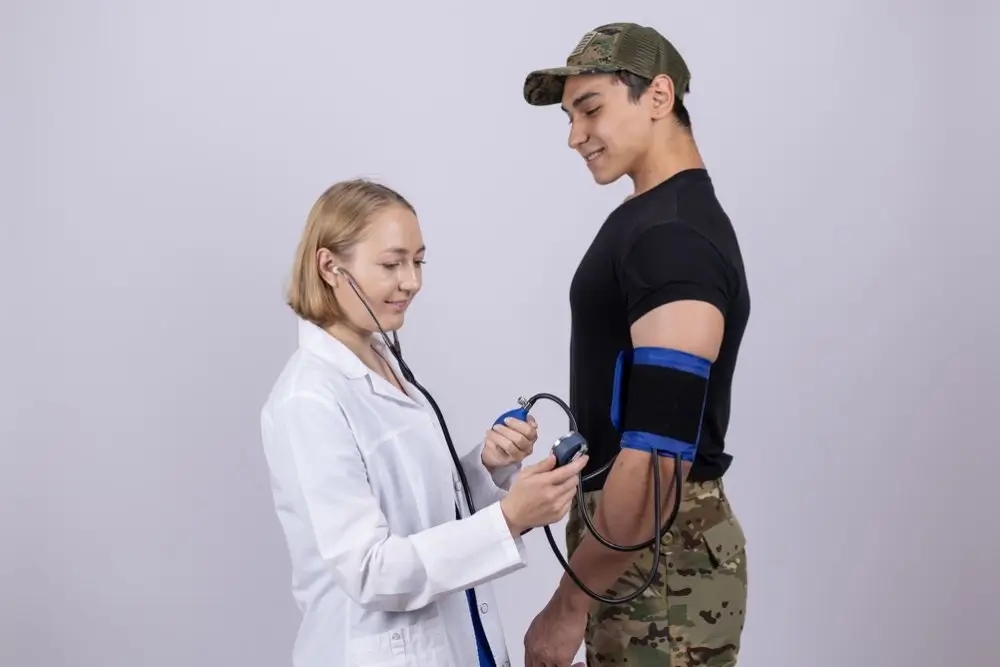
Medical clearance is one of the first real filters in the New Zealand Defence Force application process. Many people who are perfectly healthy in civilian terms discover that a condition they manage easily at home changes the picture once military training and deployment enter the equation. Understanding the standards early saves months of uncertainty.
This guide walks through what the NZDF actually checks: the Initial Health Check questionnaire, the full medical with an approved doctor, vaccination evidence, height and weight limits, vision and hearing thresholds, and the conditions that can restrict or end an application. It also covers the fitness testing that follows medical screening, because health clearance and physical standards are two separate hurdles.
 NZDF Recruitment · Aptitude & Selection 2026Next step in the process: the aptitude test.
See the format, the sections and the timing, then practise until the clock stops mattering.
Everything here comes from the official Defence Careers medical and health requirements published by the New Zealand Defence Force.
Why NZDF medical clearance matters
Initial training is mentally and physically demanding. That single fact drives the entire medical assessment. The Defence Force explains that many conditions can be easily managed in civilian life but are made worse by military duties, which is why the civilian standard of “fit and well” does not automatically translate into fitness for service.
The NZDF must be confident that the people it selects can safely complete military training and serve anywhere in the world. Deployment is the key word. On operations, medical facilities may be limited, resupply is not guaranteed, and the environment itself can aggravate conditions that are stable at home. Health checks happen upfront so that neither the applicant nor the team is exposed to avoidable risk later.
These requirements were developed by health specialists with detailed knowledge of military service. They are not generic occupational health rules borrowed from another sector. They reflect what soldiers, sailors and aviators are actually asked to do: carry loads, work in dust and heat, respond to emergencies, and operate for extended periods without easy access to a pharmacy or a specialist.
That context matters when you read the individual standards below. A rule that looks strict in isolation usually traces back to a specific operational reality.
How the NZDF medical assessment works

The medical side of the application runs across several checkpoints rather than a single appointment. Knowing the sequence helps you prepare documents at the right moment instead of scrambling later.
The Initial Health Check questionnaire
When you apply, you complete an initial health check questionnaire, commonly referred to as the IHC. This is your first formal disclosure of medical history. Prompt completion matters: the Defence Force states that timely submission of the IHC helps them assist you through the process. A delayed or incomplete IHC slows everything downstream.
Treat the IHC as a full and honest account. It is the document that shapes how the rest of your assessment proceeds, including whether additional specialist reports or tests are requested.
The full medical after an offer
If your application is successful and you are offered a position on an intake, a full medical is conducted with an approved doctor. You do not choose a doctor at random. Your CEF, the Candidate Engagement Facilitator assigned to your application, provides a list of approved practitioners.
The CEF is your main point of contact throughout. They coordinate appointments, explain what evidence is needed, and answer questions about how a specific condition may be viewed. If you are unsure whether something is worth disclosing, ask your CEF rather than guessing.
Defence Force doctor review
The medical information collected by the approved doctor is then reviewed by a Defence Force doctor. That review checks your file against the military health standard, and it must be completed before you can enlist. In practice this means two separate professional judgements: one clinical examination, one military-specific assessment of the results.
Your medical history stays confidential. The NZDF states that it will not be divulged to anyone who is not authorised to hold the information.
When a trade is not available on health grounds
Not every outcome is pass or fail. Health standards vary by trade, and a condition that rules you out of one role may be acceptable in another. If your preferred role is unavailable because of its specific health requirements, your CEF may discuss other role options that suit your circumstances better.
This is one reason to keep the conversation open with your CEF rather than withdrawing at the first setback. The published material does not describe a single automatic outcome or a formal appeal pathway for a medical assessment, but it does describe redirection to more suitable roles as a normal part of the process.
Vaccination requirements and health records

Vaccination evidence is one of the most common causes of delay, and it is entirely within your control. Start collecting records as soon as you decide to apply.
Before enlistment, applicants must provide proof of the following vaccinations:
- 3x tetanus
- 3x polio
- 3x diphtheria
- 3x pertussis
- 2x MMR
- 3x Hepatitis B
- COVID-19, with dose requirements depending on timing
For COVID-19, vaccination is mandatory. Two doses are required if your first dose was administered before 7 March 2024. One dose is sufficient if your first dose was administered on or after that date.
Accepted proof of vaccination
Not all evidence is accepted. The Defence Force accepts an immunisation status report, a letter from your GP confirming your vaccinations, or a childhood vaccination book combined with a screenshot of your My Covid Record. Blood serum results are not accepted as proof.
That last point catches people out. Serology showing immunity is not the same as documented vaccination history, and the NZDF does not treat it as a substitute.
Why you should start early
Completing the vaccination process can take up to six months. Multi-dose schedules have minimum intervals between injections, and tracking down childhood records from an old practice takes time. If you are missing doses, six months is a realistic planning horizon rather than a worst case.
Applicants who begin this work at the same time as their IHC generally avoid holding up an intake offer. Those who wait until a medical is booked often find the paperwork becomes the bottleneck.
Height, weight and trade-specific measurements
Physical measurements are straightforward to check yourself before you apply, which makes them a useful early screen.
The minimum acceptable height is 1.52 m. There is no maximum height restriction, but applicants over 1.96m may be unsuitable for specific trades. Height in itself is rarely a barrier to service; it is a factor in whether particular roles work for you.
The maximum acceptable weight is 125kg. The acceptable BMI range is 18 to 30. The NZDF may consider a BMI up to 33 if, on assessment, the BMI is found to be due to large muscle bulk. That exception is discretionary and depends on the medical assessment, not on self-reported training history.
Aircrew trades apply their own parameters. These cover height and also specific requirements for length of limbs, determined during the aircrew selection board. If you apply for an aircrew trade, the medical team measures you during the aircrew selection board to determine suitability. You will not be able to confirm this yourself in advance.
For everyone else, the practical takeaway is simple. If your BMI sits above 30 and is not attributable to muscle bulk, working on body composition before applying is a concrete step you can take now, and it also feeds directly into the fitness testing described later.
NZDF Recruitment · Aptitude & Selection 2026Next step in the process: the aptitude test.See the format, the sections and the timing, then practise until the clock stops mattering.
Vision, colour perception and hearing standards
Sensory standards are among the most trade-dependent parts of the NZDF health assessment.
Vision requirements
A high level of both uncorrected and corrected vision is required. The reasoning is operational: certain trades perform complex tasks in conditions of limited visibility, and the ability to see targets at a distance and distinguish signals matters for personal and team safety. You may be unable to wear visual aids under certain conditions, especially in an emergency. Each trade therefore sets a minimum visual requirement that you must meet.
If you are considering corrective photorefractive surgery such as LASIK, do not book it before speaking to your doctor and your CEF. Some vision-correcting procedures are not compatible with NZDF medical standards. Having LASIK done at the wrong time, or the wrong type of procedure, can close doors that were previously open. A short conversation with your CEF before surgery is far cheaper than discovering the problem at your full medical.
Colour perception
Perfect colour perception is essential for many trades. Signals, wiring, charts, munitions markings and instrument displays all rely on accurate colour discrimination, and errors carry real consequences.
Decreased colour perception does not automatically end an application. Candidates in that position can discuss other trade options with their CEF. Because colour perception is trade-specific rather than a blanket entry requirement, the practical question is which roles remain open to you, not whether service is possible at all.
If you have never been formally tested, it is worth knowing your status before you set your heart on a particular trade. Some applicants only discover a colour perception limitation during the recruitment medical, after they have already committed to a preference.
Hearing and audiograms
The NZDF only accepts candidates with perfect hearing measured at frequencies of 500, 1000, 2000, 3000, 4000, 6000 and 8000 Hz, mostly not falling below 30 Decibels in the upper frequencies.
If you have a known hearing problem, or suspect you might, it is recommended that you have an Audiogram performed by a Registered Audiologist. NZDF clinical staff then assess that Audiogram against entry standards to confirm your hearing level. Arranging an Audiogram early gives you a clear answer before you invest further time in the process.
Hearing aids and cochlear implants are not accepted. This is a firm exclusion rather than a trade-by-trade consideration, and it applies regardless of how well corrected hearing performs in daily life. The underlying issue is the same as with medication: devices can fail, be damaged or run out of power in environments where replacement is not possible.
Medication, asthma, allergies and coeliac disease
This is the section that ends the most applications, and the logic behind each rule is consistent: what happens when you are deployed and the supply chain does not reach you?
Regular and long-term medication
In general, any applicant who requires regular or long-term medication to control a medical condition will be unfit for service. Contraception is excluded from this rule.
The reason is practical. A supply of medications cannot be guaranteed in a deployed situation. Medications may be destroyed or degraded by heat and humidity, or unavailable for periods of time. A condition that is perfectly stable on daily medication in New Zealand becomes an operational risk when that medication cannot be resupplied.
This is why “my condition is well controlled” is not, by itself, an argument for fitness. The standard asks whether you remain safe and effective without reliable access to treatment.
Asthma
People with asthma may not be considered fit for operational service, and therefore not fit for military service. Training and service in the Defence Force require activities that pose a high risk of provoking asthma: vigorous exercise, firefighting, contact with dust and other irritants, and exposure to changes in temperature. Deployed medical facilities may also be limited.
Where asthma is being assessed, proof of complete asthma control is required. A negative challenge test is the kind of evidence used here. Bronchial provocation testing, such as a hypertonic saline challenge test or a mannitol challenge test, is the standard clinical method for demonstrating that airways are not hyper-responsive.
A childhood diagnosis that has not required treatment for years is not the same as active asthma, but you still need to disclose it and let the assessment run its course.
Allergies and Epipen use
Significant allergies can limit eligibility, particularly those requiring an Epipen. Anaphylaxis in a field or shipboard setting, far from definitive care, is a serious problem. Carrying an Epipen also depends on a reliable supply and correct storage, which brings the same constraints as long-term medication.
If you carry an Epipen for any reason, disclose it in your IHC and let the medical assessment determine how it applies to the trades you are considering.
Coeliac disease
Coeliac disease is described as disqualifying. The problem is dietary control on operations. Ration packs, field kitchens and shared messing arrangements cannot reliably guarantee gluten-free food, and deployment locations may offer no alternative supply.
Unlike some conditions, coeliac disease is not managed with a medication that could theoretically be stockpiled. It requires ongoing control of the food environment, which the Defence Force cannot guarantee anywhere in the world. That combination of dietary and deployment complications is why coeliac disease sits in the disqualifying category rather than the case-by-case one.
Mental health disclosure and other medical factors
Mental health is assessed as part of the same medical standard, and disclosure is required rather than optional.
What must be disclosed
Applicants must disclose mental health conditions, including but not limited to anxiety, depression, bipolar disorder, schizophrenia, substance dependence, ADHD, anorexia and bulimia. The list is explicitly not exhaustive, so if you are unsure whether a past diagnosis or treatment episode counts, disclose it.
The Defence Force explains the reasoning directly: military life can aggravate mental health conditions. Separation from family and support networks, high-tempo training, irregular sleep and operational stress all place demands on people that civilian life does not. A history of ADHD or an anxiety disorder is assessed against those demands, not against how well you function in your current routine.
Non-disclosure is the worse outcome. Concealing history undermines the assessment that exists to keep you safe, and it damages the credibility of your entire application.
Other conditions that may affect eligibility
Several other medical factors are identified as potentially disqualifying:
- Diabetes mellitus
- High blood pressure, cited at 140/90 or higher, or the use of blood-pressure medication
- Epilepsy within the last five years
- Severe headaches or migraines
- Arthritis
- Chronic back pain
- Cancer within the last five years
- Chronic fatigue syndrome
- Severe acne or isotretinoin use
- Widespread eczema
- Current pregnancy
- Endometriosis and severe PCOS
Some of these are time-bound rather than permanent. Epilepsy and cancer are both framed around a five-year window, which means the passage of time can change an assessment. Others, such as Diabetes mellitus requiring ongoing treatment, connect back to the medication rule.
Conditions like chronic fatigue syndrome, endometriosis and chronic back pain are assessed on their impact. The question is whether symptoms are compatible with sustained physical work, unpredictable hours and limited medical support.
Assessment, not self-diagnosis
The single most useful principle in this section is that a condition being manageable in civilian life does not establish fitness for NZDF duties. The military health standard weighs training and deployment demands, which is a different question from whether you cope well at home or at work.
That cuts both ways. Some applicants disqualify themselves unnecessarily because they assume a past diagnosis is fatal to their chances, when the actual assessment might have found otherwise. Others assume a stable condition will be waved through. Neither assumption is reliable. Disclose fully, let the Defence Force doctor assess, and use your CEF to understand the result.
Fitness testing after medical screening
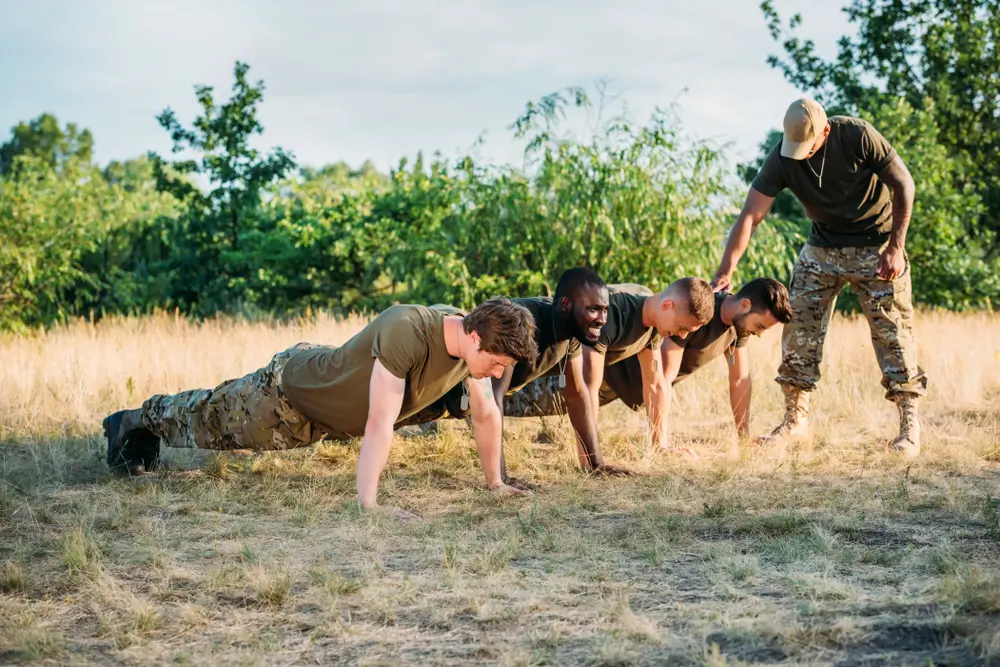
Passing the medical is not the end of the physical requirements. Fitness testing runs alongside and after medical screening, with different standards at different stages and for each service.
Assessment Day (A-Day)
A-Day fitness testing for Army and Air Force applicants includes the MSFT, or Multi-Stage Fitness Test, widely known as the beep test, plus press-ups. Results are graded rather than simply passed or failed, and your grade can affect how competitive your application is against other candidates.
Aiming only for the minimum is a weak strategy. A satisfactory or strong result strengthens your file, and it also gives you margin if you underperform on the day.
Army & Air Force Fitness Standards – Assessment Day
| GRADE | MSFT (BEEP TEST) Male | MSFT (BEEP TEST) Female | PRESS-UPS Male | PRESS-UPS Female |
|---|---|---|---|---|
| STRONG | 10.05 or greater | 8.06 or greater | 30 or greater | 15 or greater |
| 9.11 | 8.01 | 25 | 11 | |
| SATISFACTORY | 9.06 | 7.06 | 20 | 8 |
| 8.11 | 7.01 | 15 | 5 | |
| 8.06 | 6.05 | 10 | 3 | |
| MINIMUM | 7.10 | 5.09 | 5 | 1 |
| FAIL | Less than 7.10 | Less than 5.09 | Less than 5 | Less than 1 |
Some trades set their own A-Day standards well above the general minimum.
Army & Air Force – Specific Trade Standards (A-Day)
| Trade | MSFT (BEEP TEST) | PRESS-UPS |
|---|---|---|
| RNZAF Physical Training Instructor | 9.05 | 30 |
| NZSAS | 12.01 | 30 |
Navy applicants sit the same test format on A-Day, but the MSFT minimum is banded by age.
Navy MSFT Minimum Scores by Age Bracket
| Age Bracket | Male Minimum | Female Minimum |
|---|---|---|
| 16-29 | 6.10 | 5.01 |
| 30-39 | 5.09 | 4.01 |
| 40-49 | 4.09 | 3.01 |
| 50-59 | 3.08 | 2.01 |
| 60+ | 3.04 | 1.04 |
Navy press-ups minimums on A-Day are 5 for males and 1 for females, with the same graded scale above that as Army and Air Force.
Induction Day (I-Day)
I-Day brings a second round of testing. Navy and Air Force applicants must pass the A-Day fitness test again, which means you need to hold or improve your beep test and press-ups performance between the two stages. Losing conditioning after A-Day is a real risk for candidates who wait several months for an intake.
Army applicants take a different test at I-Day: the Entry Fitness Level.
Army Entry Fitness Level – Induction Day
| Gender | Press-ups | 2.4km Run (Time) |
|---|---|---|
| MALE | 15x | 12 minutes or less |
| FEMALE | 8x | 14 minutes or less |
Note the shift in emphasis. A-Day uses the MSFT to measure aerobic capacity in shuttle format, while I-Day for Army uses a timed 2.4 km run. Training only for the beep test leaves you underprepared for a continuous run, so build both into your preparation.
The Defence Force publishes a six-week challenge as an advanced pre-joining fitness programme, designed to prepare candidates for the demands of initial training. If you have a confirmed intake date, structuring the final weeks around a programme of that kind is more effective than unstructured training.
Ongoing fitness testing during service
Graduation from initial training requires passing the relevant service fitness test, and testing continues once or twice a year throughout a career. Each service uses its own battery.
The Navy uses the MSFT alongside a body drag, an equipment carry and a swim test. The Army uses the RFL, or Required Fitness Level. The Air Force uses the OFT, the Operational Fitness Test.
Navy Ongoing Fitness – Multi-Stage Fitness Test (MSFT)
| Age Group | Male | Female |
|---|---|---|
| <30 years | 7.10 | 5.09 |
| 30-40 years | 6.10 | 4.09 |
| 40+ years | 5.09 | 4.01 |
The in-service Navy MSFT standard is higher than the Navy entry minimum, which is a useful signal: entry standards are a floor, not a destination.
For the Army, the RFL sets graduation and ongoing standards by age, with both a pass and a first class pass.
Army Required Fitness Level (RFL) – Graduation Standards
| AGE | MALES 2.4km run (Pass) | MALES 2.4km run (1st Class Pass) | MALES Press ups (Pass) | MALES Press ups (1st Class Pass) | FEMALES 2.4km run (Pass) | FEMALES 2.4km run (1st Class Pass) | FEMALES Press ups (Pass) | FEMALES Press ups (1st Class Pass) |
|---|---|---|---|---|---|---|---|---|
| 16-24 | 10:16 | 9:47 | 28 | 30 | 12:47 | 12:11 | 14 | 15 |
| 25-29 | 10:39 | 10:10 | 26 | 30 | 13:03 | 12:26 | 13 | 15 |
| 30-34 | 11:02 | 10:32 | 24 | 30 | 13:39 | 13:00 | 12 | 15 |
| 35-39 | 11:26 | 10:54 | 22 | 30 | 14:16 | 13:34 | 11 | 15 |
| 40-44 | 11:51 | 11:18 | 18 | 30 | 14:56 | 14:12 | 9 | 15 |
| 45-49 | 12:17 | 11:43 | 14 | 30 | 15:36 | 14:51 | 7 | 15 |
| 50-54 | 13:05 | 12:28 | 10 | 30 | 16:33 | 15:45 | 5 | 15 |
| 55-59 | 13:531 | 13:13 | 8 | 30 | 17:31 | 16:40 | 4 | 15 |
Compare the RFL with the I-Day entry standard and the gap is obvious. A 20-year-old male passes I-Day with 15 press-ups and a 12-minute run, but needs 28 press-ups and 10:16 to pass the RFL. That improvement is expected to happen during initial training, and candidates who arrive close to the entry minimum have a much harder course.
Air Force ongoing testing uses the OFT, which includes a weighted march and a press-up component, both banded by age and fitness level.
Air Force 5-Kilometre Weighted March Time Standards
| AGE GROUPS | MALE Time (F1) | MALE Time (F2) | FEMALE Time (F1) | FEMALE Time (F2) |
|---|---|---|---|---|
| 16-29 | 42:00 | 44:00 | 44:30 | 46:30 |
| 30-39 | 44:00 | 46:00 | 46:30 | 48:30 |
| 40-49 | 46:00 | 48:00 | 48:30 | 50:30 |
| 50-59 | 48:00 | 50:00 | 50:30 | 52:30 |
| 60-69 | 50:00 | 52:00 | 52:30 | 54:30 |
| 70+ | 52:00 | 54:00 | 54:30 | 56:30 |
The march is completed with a 20 kg load for the 16 to 29 F1 standard.
Air Force Press Up Test Standards
| AGE GROUPS | MALE Repetitions (F1) | MALE Repetitions (F2) | FEMALE Repetitions (F1) | FEMALE Repetitions (F2) |
|---|---|---|---|---|
| 16-29 | 40 | 30 | 22 | 16 |
| 30-39 | 33 | 23 | 18 | 13 |
| 40-49 | 28 | 18 | 16 | 11 |
| 50-59 | 22 | 12 | 12 | 8 |
| 60-69 | 16 | 6 | 8 | 6 |
| 70+ | 10 | 2 | 5 | 2 |
Training pathways your fitness prepares you for

Medical clearance and fitness testing lead somewhere specific, and knowing the destination helps you calibrate your preparation.
Regular Force Recruit courses in the New Zealand Army run for 17 weeks. That is a continuous residential course, and the RFL standards above are what you are expected to reach by the end of it.
The Reserve Force follows a different structure. Initial training for New Zealand Army reservists runs approximately 7 weeks in total and is delivered across three stages. Module 1 is a two days introduction to Army and Reserve Force service. Module 2 is a 38 days residential Basic Training course at Waiouru Military Camp. Corps Training, the trade-specific stage, is equivalent to a 14 days commitment.
Once trained, the minimum expected Reserve Force commitment is 20 days per year. The medical and fitness standards described in this article apply to reservists as well, which is worth knowing if you assumed part-time service came with a lighter health screen.
Is it hard to get through NZDF health screening?
There is no published acceptance rate, and no single measure of difficulty. What the Defence Force does say is that initial training is mentally and physically demanding, and that applicants must clear medical checks, fitness testing and aptitude testing.
The medical side is less about difficulty and more about fit. You either meet the standard for a given trade or you do not, and much of that is determined by history rather than effort. The fitness side is different: it responds directly to preparation, and the graded scoring on A-Day rewards candidates who train seriously rather than aiming at the minimum.
Requirements also vary by service and by trade, which means a rejection for one role is not necessarily a rejection from the NZDF. That is precisely the situation where your CEF adds value.
What to do next
Three actions give you the most leverage before you apply.
Start your vaccination records now. The process can take up to six months, and the accepted evidence is specific: an immunisation status report, a GP confirmation letter, or a childhood vaccination book plus a My Covid Record screenshot. Blood serum results will not be accepted.
Check the measurable standards you can verify yourself: height against the 1.52 m minimum, weight against the 125kg maximum, and BMI against the 18 to 30 range. If any of these are outside range, you know your first project.
Build your fitness against the graded scales rather than the minimums, and train both the MSFT and the 2.4 km run if you are heading for the Army. Then complete your IHC honestly and early, and use your CEF as your route to answers on anything specific to your medical history.
Frequently Asked Questions
What are the medical requirements for joining the NZDF?
You complete an Initial Health Check questionnaire when you apply. If you receive an offer for an intake, you attend a full medical with an approved doctor from a list supplied by your CEF, and a Defence Force doctor reviews the information before enlistment. The assessment covers vaccinations, height and weight, vision, hearing, medication, asthma, allergies, mental health and other medical factors.
What medical conditions can affect NZDF eligibility?
Several factors can affect eligibility, including regular or long-term medication, asthma, significant allergies, coeliac disease, mental health conditions and a range of other medical conditions. Coeliac disease is described as disqualifying, while other conditions may be limiting or may require further assessment. Disclose your full medical history rather than relying on your own judgement about what matters.
How do you get medically cleared for the NZDF?
Complete the IHC promptly during the application process. If you are offered a place on an intake, attend the full medical with an approved doctor supplied by your CEF. A Defence Force doctor then reviews the medical information against the military health standard before enlistment.
What happens if you fail an NZDF or Army medical test?
There is no single automatic outcome published, and no formal appeal process is described. Medical information is reviewed by a Defence Force doctor before enlistment, and if a preferred trade is unavailable because of its health requirements, your CEF may discuss other suitable roles with you.
Do medication or asthma disqualify you from joining the NZDF?
Applicants who need regular or long-term medication are generally considered unfit for service, with contraception excluded, because supplies cannot be guaranteed during deployment. Asthma may make an applicant unfit for operational and therefore military service, and evidence of complete asthma control, such as a negative challenge test, is required where relevant.
Are there height, weight, eyesight and hearing requirements for the NZDF?
Yes. The minimum acceptable height is 1.52 m, the maximum acceptable weight is 125kg, and the standard BMI range is 18 to 30, with BMI up to 33 potentially considered when it is due to muscle bulk. Vision requirements vary by trade, hearing is assessed at set frequencies, and hearing aids and cochlear implants are not accepted.
What vaccinations are required for NZDF medical clearance?
You must provide proof of tetanus, polio, diphtheria, pertussis, MMR, Hepatitis B and COVID-19 vaccinations before enlistment. Accepted evidence includes an immunisation status report, a GP confirmation letter, or a childhood vaccination book with a My Covid Record screenshot. Blood serum results are not accepted, and you should begin early because the process can take up to six months.
Is it hard to join the NZDF?
Initial training is described as mentally and physically demanding, and applicants must complete medical checks, fitness testing and aptitude testing. Fitness results are graded and can affect competitiveness, and requirements vary by service and trade. No overall acceptance rate or single measure of difficulty is published.
What fitness tests are required after NZDF medical screening?
A-Day includes the MSFT and press-ups for Army and Air Force applicants, with separate standards for some trades. At I-Day, Navy and Air Force applicants repeat the A-Day test, while Army applicants complete the Entry Fitness Level test with press-ups and a 2.4 km run. Service-specific testing continues through initial training and throughout a career.

Sources
NZDF Recruitment · Aptitude & Selection 2026Next step in the process: the aptitude test.See the format, the sections and the timing, then practise until the clock stops mattering.

Navy Basic Training NZ: RNZN BCT Length, Skills and Entry
How Long Is Army Basic Training? NZ Army RRF Course Explained