
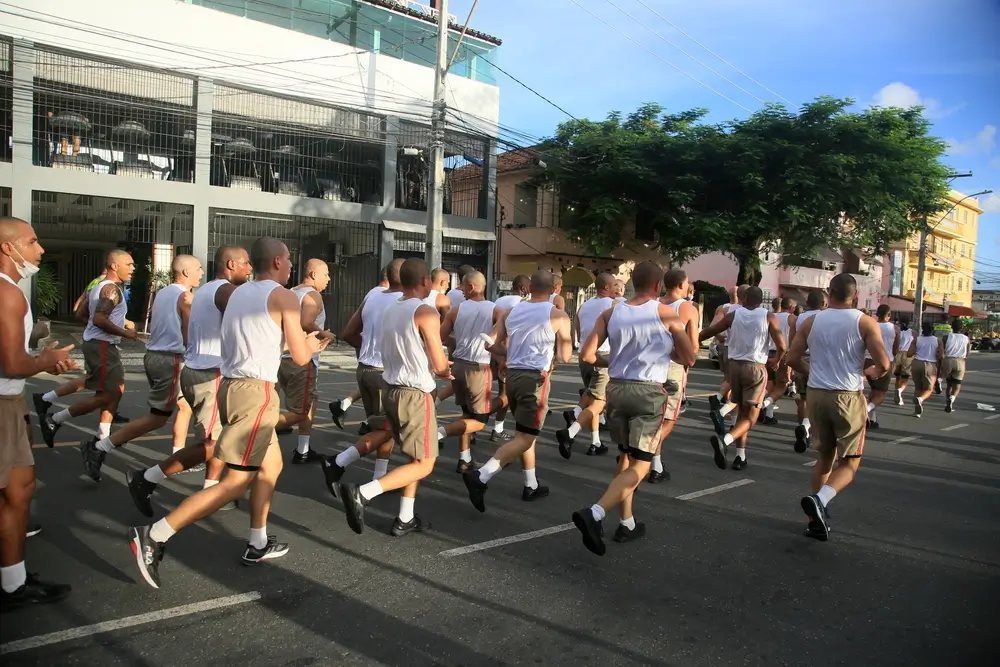
If you are booked in for an NZDF Assessment Day, the number you need on the beep test depends on your service, your sex and, for the Navy, your age. There is no single New Zealand Defence Force pass mark, and old figures still circulate online. This guide sets out the current official standards from the NZDF Defence Careers medical and fitness page, explains how the multistage fitness test is run, and shows how to find the exact target that applies to you.
What the beep test is in New Zealand
The proper name is the multistage fitness test, usually shortened to MSFT, but nearly everyone in New Zealand calls it the beep test. Most people meet it first at school, then again at a recruitment assessment.
 NZDF Recruitment · Aptitude & Selection 2026Train the test you cannot run.
The cognitive assessment gets far less preparation than the beep test does. Give it the same discipline.
The format is simple. Participants run back and forth across a 20-metre distance, in a gym or on a field, keeping time with pre-recorded beeps. Those beeps get more frequent as the test moves through its levels, so the pace keeps rising. When you can no longer reach the line before the beep, you are eliminated, and your score reflects how long you lasted.
That simplicity is why the multistage fitness test is so widely used. Nicholas Gant, head of the department of exercise science at the University of Auckland, told The Spinoff in December 2025:
“It’s simple to administer, requires minimal equipment, and provides a reasonably accurate estimate of cardiorespiratory fitness without the need for scientific skills or lab equipment.”
Scores are written as a level and a shuttle, which is why NZDF standards look like 7.10 or 5.09 rather than a round number. The level comes first, the shuttle within that level comes second.
Where the MSFT fits in NZDF selection
Fitness testing in the NZDF happens at two points in the joining process: Assessment Day, often written A-Day, and Induction Day. Assessment Day includes the MSFT beep test and press-ups.
Your result is not just pass or fail. The NZDF states that Assessment Day fitness results affect how competitive you are during selection, so scoring well above the minimum works in your favour when places are contested.
The official Defence Careers page presents separate Assessment Day standards for Army and Air Force candidates and for Navy candidates. That split is the single most common source of confusion among applicants, and it is why a number quoted by a friend who joined a different service may not apply to you.
Army and Air Force beep test requirements
Army and Air Force applicants share one Assessment Day table. It grades both the MSFT and press-ups on the same scale, from Strong down to Fail.
Army & Air Force Fitness Standards – Assessment Day
| GRADE | MSFT (BEEP TEST) Male | MSFT (BEEP TEST) Female | PRESS-UPS Male | PRESS-UPS Female |
|---|---|---|---|---|
| STRONG | 10.05 or greater | 8.06 or greater | 30 or greater | 15 or greater |
| 9.11 | 8.01 | 25 | 11 | |
| SATISFACTORY | 9.06 | 7.06 | 20 | 8 |
| 8.11 | 7.01 | 15 | 5 | |
| 8.06 | 6.05 | 10 | 3 | |
| MINIMUM | 7.10 | 5.09 | 5 | 1 |
| FAIL | Less than 7.10 | Less than 5.09 | Less than 5 | Less than 1 |
The minimum row is the line you must clear, not the score you should aim for. A male applicant who stops at 7.10 has met the standard; one who reaches 9.06 sits at Satisfactory, and 10.05 or above is graded Strong. The same logic applies on the female column, where 5.09 is the minimum and 8.06 or greater is Strong.
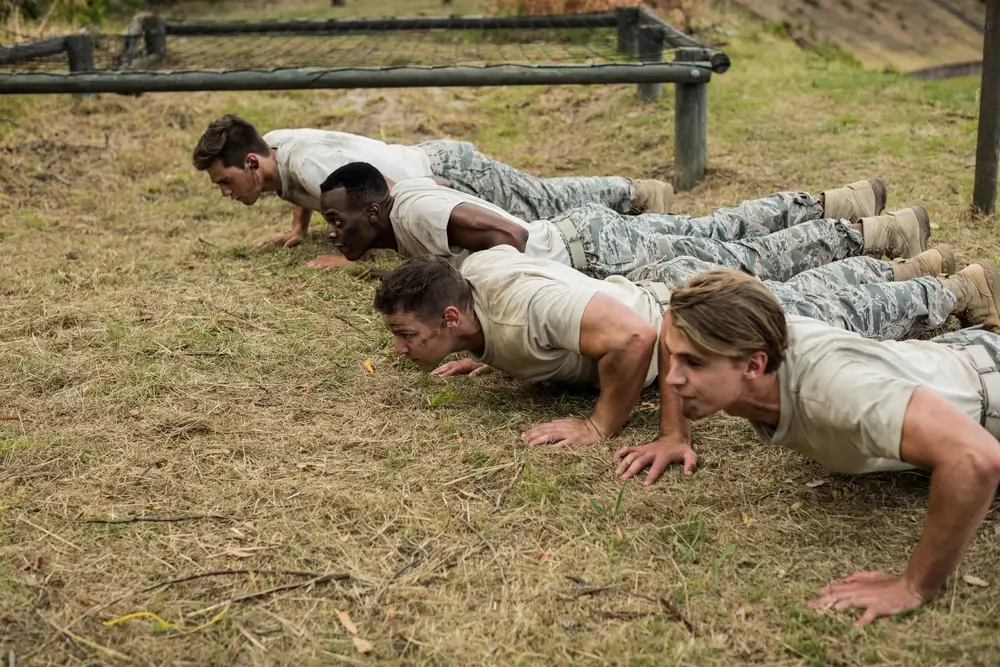
Note also that press-ups sit alongside the beep test in the same grade band. Five press-ups for males and one for females is the bare minimum, while 30 and 15 respectively are needed for a Strong grade. Training the beep test alone leaves half the assessment untouched.
The Defence Careers page presents separate Assessment Day standards for Army and Air Force candidates and for Navy candidates. Those figures of 7.10 for Army males and 5.09 for Army females are the current official standards from the Defence Careers page. Use the official table above.
Navy beep test requirements and age bands
The Navy is graded on its own Assessment Day table, and its minimum row is set lower than the Army and Air Force equivalent for the youngest applicants.
Navy Fitness Standards – Assessment Day
| GRADE | MSFT (BEEP TEST) Male | MSFT (BEEP TEST) Female | PRESS-UPS Male | PRESS-UPS Female |
|---|---|---|---|---|
| STRONG | 10.05 or greater | 8.06 or greater | 30 or greater | 15 or greater |
| 9.11 | 8.01 | 25 | 11 | |
| SATISFACTORY | 9.06 | 7.06 | 20 | 8 |
| 8.11 | 7.01 | 15 | 5 | |
| 8.06 | 6.05 | 10 | 3 | |
| MINIMUM | 6.10** | 5.01** | 5 | 1 |
| FAIL | Less than 6.10** | Less than 5.01** | Less than 5 | Less than 1 |
The starred minimums apply to applicants aged 16 to 29. Older Navy applicants are held to different thresholds, set out in a separate age-banded table.
Navy Beep Test Minimum by Age
| Age Group | MALE | FEMALE |
|---|---|---|
| 16-29 | 6.10 | 5.01 |
| 30-39 | 5.09 | 4.01 |
| 40-49 | 4.09 | 3.01 |
| 50-59 | 3.08 | 2.01 |
| 60+ | 3.04 | 1.04 |
Before you commit a number to memory, check three things: your service, your age band, and which testing stage the figure belongs to. The Defence Careers page publishes more than one Navy beep test table, and the Assessment Day minimum is not the same reference point as ongoing service standards. Label the number you are training towards by its stage, or you risk preparing for the wrong target.
Trade-specific standards
Some trades set their own MSFT bar well above the general Assessment Day minimum, and it is published separately.
RNZAF Specific Standards – Assessment Day
| Trade | MSFT (BEEP TEST) | PRESS-UPS |
|---|---|---|
| RNZAF Physical Training Instructor | 9.05 | 30 |
| NZSAS | 12.01 | 30 |
A RNZAF Physical Training Instructor needs 9.05 with 30 press-ups. NZSAS sits at 12.01 with 30 press-ups, comfortably above the Strong grade on the general table. If your chosen trade appears in a specific standards table, that figure replaces the general minimum for your application.
NZDF Recruitment · Aptitude & Selection 2026Train the test you cannot run.The cognitive assessment gets far less preparation than the beep test does. Give it the same discipline.
How the 20-metre test is conducted

Two markers are placed 20 metres apart. You start behind one line and run to the other, arriving before the beep sounds, then turn and run back. The recorded audio track controls the entire test, so pacing is dictated for you rather than chosen.
As the levels advance, the interval between beeps shortens. What feels comfortable jogging in the early levels becomes a hard run within a few minutes. The moment you can no longer reach the line in time with the required pace, you are out.
Your score is the level and shuttle you reached, not a fixed distance everyone completes. That is the reason two candidates in the same session finish with very different numbers, and why the notation matters when you compare yourself to the official tables.
What the MSFT score actually measures
The beep test is a reliable indicator of general fitness for prolonged physical activity, according to Gant. It works because the shuttle runs engage large muscle groups and demand whole-body movement, while the rising intensity increases oxygen demand at every level.
“The participant typically reaches exhaustion shortly after hitting their maximum oxygen uptake, known as VO₂max.”
That maximum reflects aerobic capacity, which in most people is determined by cardiac output. Gant also notes that the test is useful for identifying athletic potential, since a high VO₂max is often a prerequisite for elite performance and is largely genetically influenced. Most participants will also reach close to their maximal heart rate by the end.
For an NZDF applicant, that means your MSFT result is a direct read on cardiorespiratory fitness under progressive load, which is precisely what the standards are screening for.
How to prepare before Assessment Day
Preparation should mirror what the test demands: repeated changes of direction at rising speed, not a steady distance run. The stop, turn and re-accelerate pattern of the 20-metre shuttle costs far more than covering the same distance in a straight line, so practising on a properly measured course matters.
Build aerobic capacity through progressive intervals so your body is used to working close to maximal heart rate for the final levels. Because the test can be run with minimal equipment, you can rehearse it with two markers, a tape measure and an audio track, then track improvement week by week.
Do not neglect press-ups. Both elements are graded on Assessment Day, and a Strong beep test paired with a Minimum press-up count still leaves a weak overall picture. The official Defence Careers fitness page also includes guidance on improving fitness before Assessment Day, which is worth reading alongside the standards tables.
Set your target above the minimum. Since fitness results influence how competitive your application is, aiming for the Satisfactory or Strong bands gives you margin on the day, when nerves, heat or a bad night’s sleep can cost you a shuttle or two.
How to check the correct standard before test day
Work through it in order. First, identify your service, because Army and Air Force share one table while the Navy has its own. Second, check your age band if you are applying to the Navy, where five groups run from 16–29 through to 60+. Third, confirm the testing stage, since Assessment Day and Induction Day figures are published separately. Fourth, check whether your trade carries a specific standard such as 9.05 or 12.01.
Read the grade labels rather than the numbers alone. Strong, Satisfactory, Minimum and Fail all appear in the same table, and it is easy to memorise a Satisfactory figure while believing it is the pass mark, or the reverse.
When in doubt, the Defence Careers medical and fitness page is the reference, not a forum post or an old social media graphic. Recruitment standards change, and the figures published there are the ones your assessors will use.
Frequently Asked Questions
What is the beep test in New Zealand?
It is the common name for the multistage fitness test, or MSFT. Participants run 20-metre shuttle runs timed to beeps that get progressively faster, and the final score is based on how long they keep pace before being eliminated.
Is the beep test 20 metres?
Yes. The course requires you to run back and forth across a 20-metre distance while synchronising each run with pre-recorded beeps.
What are the beep test requirements for the New Zealand Army?
The official NZDF Army and Air Force Assessment Day table lists a minimum MSFT score of 7.10 for males and 5.09 for females. Anything below those figures is marked Fail. Check as well whether your chosen trade sets a higher specific standard.
Are the Army, Navy and Air Force beep test requirements the same?
No. The Defence Careers page separates Army and Air Force standards from Navy standards, and the Navy table is age-banded. For ages 16 to 29, the Navy minimum is 6.10 for males and 5.01 for females, which differs from the Army and Air Force minimums.
What is the Navy beep test minimum for NZDF selection?
For Navy applicants aged 16 to 29, the Assessment Day minimum is 6.10 for males and 5.01 for females. The Navy minimum-by-age table sets lower thresholds for older age groups, so check your age band and testing stage.
What happens during the NZDF beep test on Assessment Day?
You complete repeated 20-metre shuttle runs timed to recorded beeps that become progressively more frequent. Assessment Day includes both the MSFT and press-ups, and NZDF states that fitness results affect how competitive your application is.
How hard is 7.5 on the beep test?
There is no universal difficulty rating attached to 7.5. The test gets harder as the beeps speed up, and NZDF thresholds vary by service, age and testing stage, so compare the notation against the official table for your own application rather than treating it as a general pass mark.
What does MSFT stand for?
MSFT stands for multistage fitness test. It is the formal name for the beep test used in NZDF material and in New Zealand descriptions of the 20-metre shuttle test.
Does the NZDF use the beep test for all three services?
Yes, the beep test is part of the fitness requirements for the Army, Air Force and Navy. The Assessment Day thresholds are not identical across those services, so use the table for your own service and stage.
Is the beep test the only NZDF fitness requirement?
No. Assessment Day covers the MSFT and press-ups, and fitness testing also takes place at Induction Day. The official page sets out service- and trade-specific fitness standards as well, so the beep-test minimum is not the full picture.
Next step
Confirm your service, age band and trade, then write down the exact figure from the matching table and treat it as your floor rather than your goal. Build a shuttle-running programme around that number, add press-ups to every session, and re-test yourself on a measured 20-metre course every few weeks so you arrive at Assessment Day knowing where you sit.
Sources
NZDF Recruitment · Aptitude & Selection 2026Train the test you cannot run.The cognitive assessment gets far less preparation than the beep test does. Give it the same discipline.

How to Train for the Beep Test: A 6-Week Practical Plan

Good Beep Test Score by Age: Full Charts for Men and Women