

Joining the New Zealand Army means passing fitness tests at several distinct points, and the standards change as you move through the process. The beep test that matters on Assessment Day is not the test you face on Induction Day, and neither is the test you will repeat every six months once you are serving.
This guide sets out what each stage asks of you, using the figures published by Defence Careers and the NZDF Health Hub. Numbers are the starting point, but knowing the sequence matters just as much, because it tells you what to train for and when.
 NZDF Recruitment · Aptitude & Selection 2026Train the test you cannot run.
The cognitive assessment gets far less preparation than the beep test does. Give it the same discipline.
The three fitness checkpoints in the Army pathway
The official joining pages describe a sequence that runs from Assessment Day (A-Day), to Induction Day (I-Day), and then into ongoing service testing once you are in uniform.
On A-Day you complete a multi-stage fitness test (MSFT, better known as the beep test) alongside a press-up test, plus aptitude testing. Your fitness result is graded, so it feeds into how competitive your application looks overall.
At I-Day, Army recruits take the Entry Fitness Level test instead. The beep test drops out at this point and a 2.4km run takes its place, still paired with press-ups.
Once you are serving, the two main tests are the Required Fitness Level (RFL) test and the Land Combat Fitness Test (LCFT). Depending on your role and unit, other tests can apply, such as the Basic Water Swim Test, with advance notice given if build-up training is needed.
One point worth taking seriously: the Defence Careers FAQ describes the published entry figures as minimum requirements, and urges candidates who want a competitive application to perform well beyond them. Treating the minimum as a target is the wrong approach. The standards pages also do not display a publication date, so confirm every figure with your recruiter or Candidate Engagement Facilitator before you test.
Army Assessment Day: MSFT and press-ups
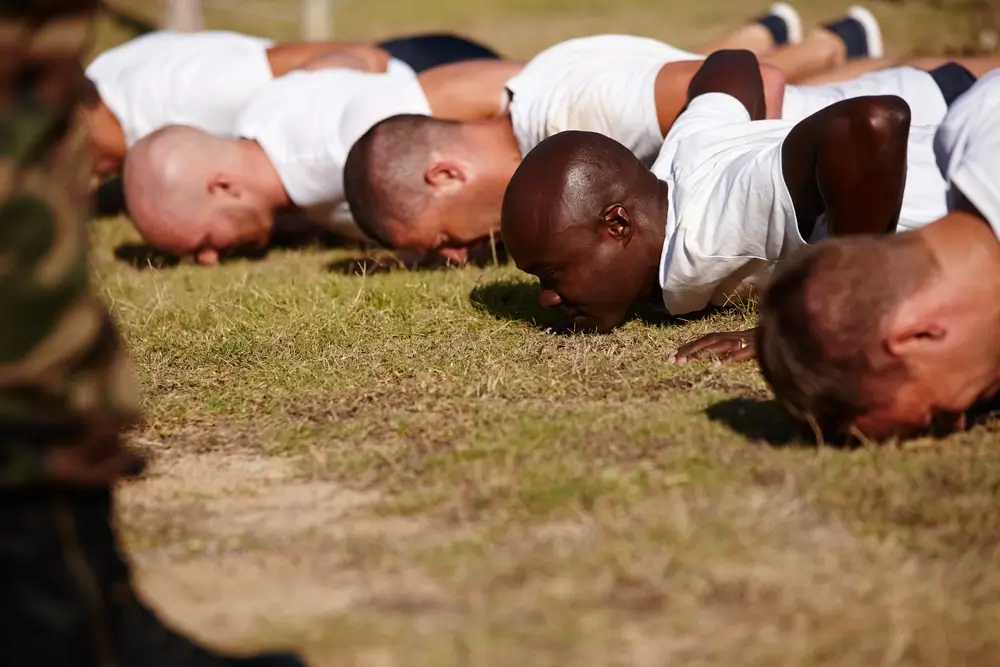
The Assessment Day standards for Army are published in a graded table running from Strong down to Fail. The male MSFT minimum is Level 7.10 and the female minimum is Level 5.09, with press-up minimums of 10 and 3 respectively.
| GRADE | MSFT (BEEP TEST) Male | MSFT (BEEP TEST) Female | PRESS-UPS Male | PRESS-UPS Female |
|---|---|---|---|---|
| STRONG | 10.05 or greater | 8.06 or greater | 30 or greater | 15 or greater |
| SATISFACTORY | 9.06 | 7.06 | 25 | 11 |
| SATISFACTORY | 8.11 | 7.01 | 20 | 8 |
| SATISFACTORY | 8.06 | 6.05 | 15 | 5 |
| MINIMUM | 7.10 | 5.09 | 10 | 3 |
| FAIL | Less than 7.10 | Less than 5.09 | Less than 5 | Less than 1 |
The gap between the Minimum row and the Strong row is large, and that gap is the point. Several Satisfactory bands sit between them, which is why hitting the bottom line of the table is not a strong result. If you can reach a Satisfactory or Strong grade before A-Day, do it.
Some specialist trades set their own bar well above the general Army standard. Selection for the NZSAS, for example, is published with an MSFT requirement of Level 12.01 and 30 press-ups. Ask your recruiter whether your preferred trade carries a higher standard before you build your training plan.
Army Induction Day and the Entry Fitness Level

Induction Day is the second fitness checkpoint, and it uses the Army Entry Fitness Level test. The published figures are a 2.4km run in 12 minutes or less for males and 14 minutes or less for females, plus 15 press-ups for males and 8 for females.
That shift from a beep test to a timed run changes what you need to train. Shuttle running rewards repeated acceleration and change of direction; the 2.4 km run rewards sustained pace over a fixed distance. Candidates who prepare only for the beep test sometimes find the run harder than expected, particularly if they have never run it under timing conditions.
The press-up requirement also rises between the two days, from 10 to 15 for males and from 3 to 8 for females. Build your press-up volume steadily across the whole application period rather than in the final fortnight.
NZDF Recruitment · Aptitude & Selection 2026Train the test you cannot run.The cognitive assessment gets far less preparation than the beep test does. Give it the same discipline.
The Required Fitness Level once you are serving
The RFL is the recurring service test for Army personnel. It assesses aerobic fitness through the 2.4km run and upper-body performance through press-ups.
The run is timed and recorded to the nearest whole second. The press-up component is performed continuously from a front support position, with specific body-alignment and movement requirements and no time limit. It is not a two-minute test, so pacing and technique matter more than an early sprint of repetitions.
Results are graded as a Standard Pass or a 1st Class Pass. Defence Careers identifies the 1st Class Pass as the desired Army standard, while the NZDF Health Hub publishes both thresholds by age and sex.
RFL standards by age and sex
Army Required Fitness Level (RFL) – Male
| Age | RUN Standard Pass | RUN 1st Class Pass | PRESS UPS Standard Pass | PRESS UPS 1st Class Pass |
|---|---|---|---|---|
| 16-24 | 10:16 | 9:47 | 25 | 30 |
| 25-29 | 10:39 | 10:10 | 25 | 30 |
| 30-34 | 11:02 | 10:32 | 23 | 28 |
| 35-39 | 11:26 | 10:54 | 21 | 26 |
| 40-44 | 11:51 | 11:18 | 19 | 24 |
| 45-49 | 12:17 | 11:43 | 17 | 22 |
| 50-54 | 13:05 | 12:28 | 15 | 20 |
| 55-59 | 13:53 | 13:13 | 13 | 18 |
| 60-64 | 14:54 | 14:11 | 11 | 16 |
| 65-69 | 15:56 | 15:10 | 9 | 14 |
Army Required Fitness Level (RFL) – Female
| Age | RUN Standard Pass | RUN 1st Class Pass | PRESS UPS Standard Pass | PRESS UPS 1st Class Pass |
|---|---|---|---|---|
| 16-24 | 12:47 | 12:11 | 15 | 20 |
| 25-29 | 13:03 | 12:26 | 15 | 20 |
| 30-34 | 13:39 | 13:00 | 13 | 18 |
| 35-39 | 14:16 | 13:34 | 11 | 16 |
| 40-44 | 14:56 | 14:12 | 9 | 14 |
| 45-49 | 15:36 | 14:51 | 7 | 12 |
| 50-54 | 16:33 | 15:45 | 5 | 10 |
| 55-59 | 17:31 | 16:40 | 3 | 8 |
| 60-64 | 18:45 | 17:50 | 1 | 6 |
| 65-69 | 19:59 | 19:00 | 1 | 4 |
Use these tables for the age band you will fall into on test day, not the one you are in today. Check the applicable thresholds with your unit or a Physical Training Instructor before you test.
The 4km walk option for medically excused personnel
Personnel who are medically excused from the 2.4km run can complete a 4km walk test instead, which assesses cardio-respiratory fitness and leg-muscle endurance. The walk is done alongside the other RFL exercises rather than replacing the assessment as a whole.
| Age | Males (mins) | Females (mins) |
|---|---|---|
| 17 – 21 | 34.00 | 37.00 |
| 22 – 26 | 34.30 | 37.30 |
| 27 – 31 | 35.00 | 38.00 |
| 32 – 36 | 35.30 | 38.30 |
| 37 – 41 | 36.00 | 39.00 |
| 42 – 46 | 36.30 | 39.30 |
| 47 – 51 | 37.00 | 40.00 |
| 52+ | 37.30 | 40.30 |
The Land Combat Fitness Test
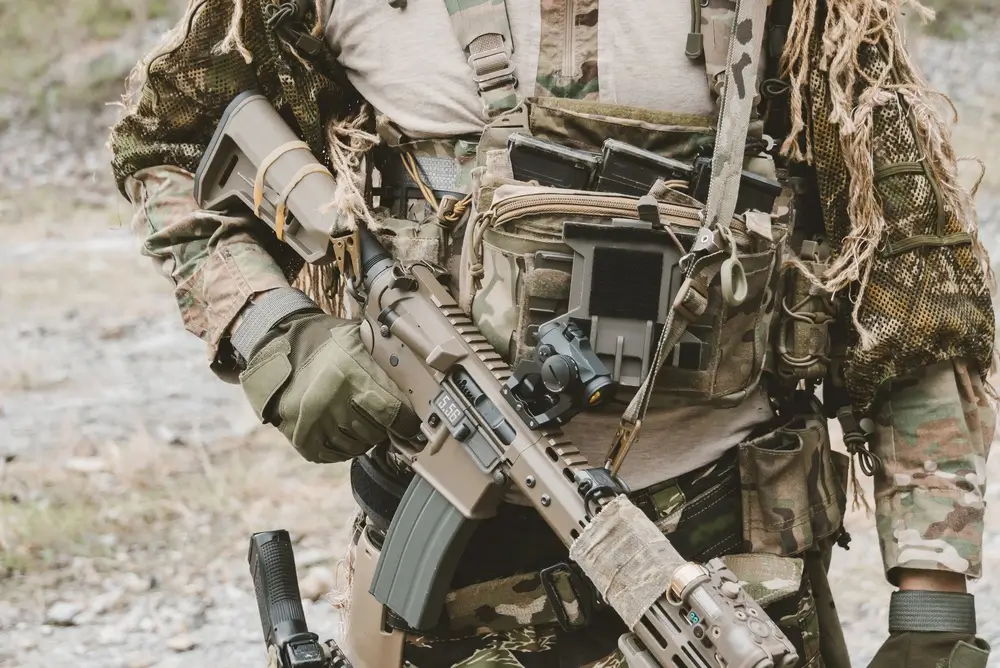
The LCFT is the functional half of Army service testing. It evaluates physical readiness to perform the role of an All Arms Soldier, and it applies the same standards to everyone.
Participants dress in patrol order and carry a 20 kg load made up of rifle, webbing and body armour. Everyone is weighed before the start, and additional weight can be added to make sure the load requirement is met, regardless of gender or body size.
The Lift and Place component tests the ability to move stores safely: a 20 kg jerry can is lifted onto a vehicle deck about 1.4 m high, 10 times in under 90 seconds. Battlefield Manoeuvre involves advancing 50 metres in bounds under time constraints. Lift and Carry requires two 20 kg jerry cans to be carried over 200 metres in 3 minutes and 15 seconds.
The final component, Battlefield Endurance, covers 4 km carrying the 20 kg load in less than 32 minutes. Participants can run or walk, which makes pacing strategy part of the test rather than raw running speed.
How often you are tested, and what happens if you fail
Regular Force members must be RFL qualified every six months, or every 12 months where a higher level of fitness has been demonstrated. Territorial Force personnel qualify once in each training year. Anyone nominated for operational deployment must be RFL qualified for that nomination to be considered, with further testing built into pre-deployment training.
You receive a reminder one month before your qualification expires, but the responsibility to attend unit testing or book a duty testing session sits with you.
Failing a test triggers a retest within a set window unless command or medical grants an exemption. The LCFT is normally retaken within 4 weeks and the RFL within 2 weeks. If the retest is also unsuccessful, you work with your command and local PTI on a remedial training programme, and a medical assessment may be required to rule out underlying health issues. Deployment eligibility, promotion and course attendance can all be affected, which is the practical reason to seek support early.
Most personnel train through unit programmes run by PTIs, and the Health Hub notes that soldiers with a base level of habitual fitness should meet test standards without much extra specific training. Where problems persist, managers, Defence Health Centres and Exercise Rehabilitation Instructors can help with injury and rehabilitation issues.
Medical standards you also need to meet
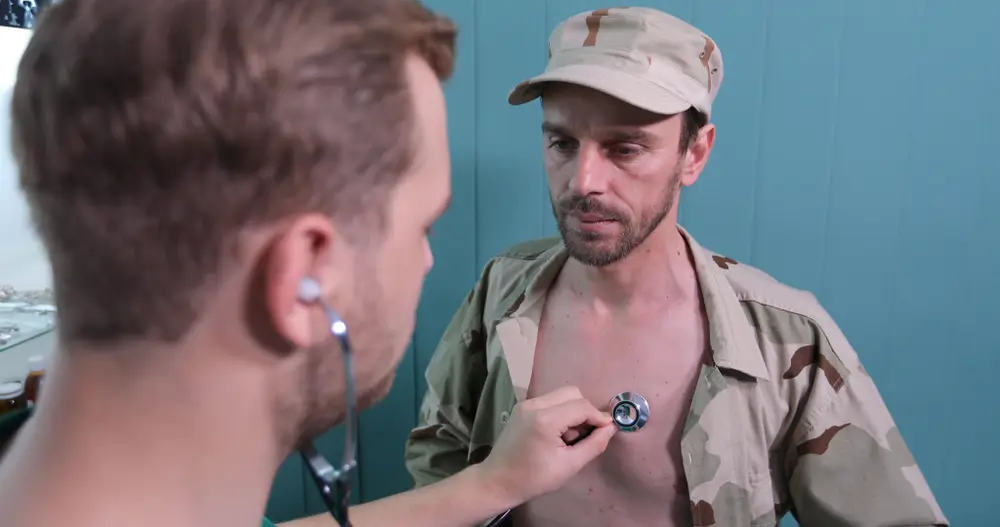
Fitness is only half of the physical screening. NZDF applicants must also meet medical standards covering general health, eyesight and hearing.
You complete an initial health check questionnaire when you apply. If you are offered a place on an intake, a full medical is carried out by an approved doctor from a list supplied by your Candidate Engagement Facilitator, then reviewed by a Defence Force doctor before enlistment. Your chosen trade may add its own health requirements.
The minimum acceptable height is 1.52 m. There is no maximum height, though applicants over 1.96 m may be unsuitable for specific trades, and aircrew trades set their own height and limb-length parameters. The maximum acceptable weight is 125 kg, and the acceptable BMI range is 18 to 30, with BMI up to 33 considered only where assessment shows it is due to large muscle bulk.
Vision standards require a high level of both uncorrected and corrected vision plus the required colour perception, because trades need to perform complex tasks in limited visibility and visual aids cannot always be worn. If you are considering corrective surgery such as LASIK, speak to your doctor and your CEF first, since some procedures are not compatible with the medical standard.
Hearing is measured at 500, 1000, 2000, 3000, 4000, 6000 and 8000 Hz, mostly not falling below 30 Decibels in the upper frequencies. Hearing aids and cochlear implants are not accepted. If you suspect a hearing issue, an audiogram from a registered audiologist can be assessed against entry standards.
Conditions that may exclude you or need discussion
Applicants who need regular or long-term medication to control a condition are generally considered unfit for service, with contraception excluded from that rule, because medication supply cannot be guaranteed on deployment.
Asthma may make an applicant unfit for operational service, since training involves vigorous exercise, firefighting, dust and irritants, and temperature changes, all of which can provoke symptoms. The outcome depends on military medical assessment. Significant allergies can also limit entry, particularly where an EpiPen is required or asthma is involved, and the official medical summary states that coeliac disease leads to non-admission because of dietary limitations on deployment.
Mental health history must be disclosed. Depression, anxiety disorders, bipolar disorder, schizophrenia and substance dependence are all listed, because military life can aggravate them. Other conditions flagged as potentially limiting include diabetes mellitus, blood pressure of 140/90 or above, epilepsy within 5 years, severe headaches or migraines, arthritis, chronic back pain, cancer within 5 years and current pregnancy.
Disclose everything and expect that some conditions require a report from your GP or a specialist. Many outcomes are decided individually rather than by a blanket rule.
Where to start
Pick your first checkpoint and train specifically for it. If A-Day is next, that means beep test work and press-up volume. If you already have a place and I-Day is coming, shift to timed 2.4 km runs at target pace and keep building press-ups.
Then confirm the numbers. Standards can be updated, trade requirements vary, and your Candidate Engagement Facilitator or Army recruiting office can tell you exactly which table applies to you before you test.
Frequently Asked Questions
What are the fitness requirements for the New Zealand Army?
There are three fitness stages. A-Day uses the MSFT and press-ups, I-Day uses the Entry Fitness Level with press-ups and a 2.4 km run, and serving personnel take the RFL and the LCFT. The published figures are minimums, and the Defence Careers FAQ advises candidates to perform beyond them. Confirm current figures with your recruiter before testing.
What are the minimum fitness requirements for Army Assessment Day?
The official A-Day table sets an MSFT minimum of Level 7.10 for males and Level 5.09 for females, with 10 press-ups for males and 3 for females. Satisfactory and Strong grades are also published, so the minimum is not the only useful target.
What is the New Zealand Army’s 2.4km requirement?
At I-Day, males must complete 2.4 km in 12 minutes and females in 14 minutes. Once serving, the RFL applies age and sex based standards, such as 10:16 for a male Standard Pass aged 16-24 and 12:47 for a female Standard Pass in the same band. Check the applicable table with Army recruiting or your unit.
What happens on Army Induction Day?
I-Day includes the Entry Fitness Level test rather than the A-Day beep test. The published standards are a 2.4 km run in 12 minutes for males or 14 minutes for females, plus at least 15 press-ups for males or 8 for females.
What are the Army RFL standards after joining?
The RFL pairs a 2.4 km run with continuous press-ups and publishes Standard Pass and 1st Class Pass thresholds by age and sex. For ages 16-24, the NZDF Health Hub lists 10:16 and 25 press-ups for a male Standard Pass, and 12:47 and 15 press-ups for a female Standard Pass. The full table runs through to the 65-69 band.
What is the Army Land Combat Fitness Test?
The LCFT is a functional test of readiness to perform the All Arms Soldier role, with the same standards for all participants. Components include a 20 kg carried load, lifting a 20 kg jerry can 10 times in under 90 seconds, battlefield manoeuvre, carrying two 20 kg jerry cans over 200 metres in 3 minutes and 15 seconds, and a 4 km Battlefield Endurance task with a 20 kg load in under 32 minutes.
What happens if you fail an Army fitness test?
The NZDF Health Hub states that an LCFT retest is normally required within 4 weeks and an RFL retest within 2 weeks, unless a medical or command exemption applies. An unsuccessful retest can lead to remedial training and may affect deployment, promotion or course attendance. Talk to a PTI early about technique and training support.
Can I join the Army if I am not fit yet?
You still have to pass the applicable minimum tests to progress. The official eligibility page says NZDF fitness levels are achievable with effort and that support is provided through the process. Do not assume that sitting close to a threshold is enough, since the Defence Careers FAQ recommends performing well beyond the minimum for a competitive application.
What medical conditions can disqualify you from joining the New Zealand Army?
The official medical page does not treat every condition as an automatic exclusion. Regular or long-term medication is generally incompatible with service, hearing aids and cochlear implants are not accepted, and coeliac disease leads to non-admission. Asthma, allergies, mental health conditions and several chronic or recent conditions are decided individually. Disclose everything and confirm the outcome with the approved doctor and your recruiter.
Can you join the New Zealand Army with ADHD?
The official medical material does not publish an ADHD-specific yes-or-no rule. Applicants must disclose their medical history, and mental health conditions may affect fitness for service. ADHD should be discussed with your Candidate Engagement Facilitator and Defence medical staff rather than assumed to be acceptable or disqualifying.
Sources
NZDF Recruitment · Aptitude & Selection 2026Train the test you cannot run.The cognitive assessment gets far less preparation than the beep test does. Give it the same discipline.

Beep Test Audio: Correctly Timed 20 m MP3 and Setup Guide

Beep Test Distance: Full 20m Level Chart and Conversions